Buying backlinks: the 12 months after the purchase
Accounts of buying links stop on the day of publication, which is where the stretch that decides the outcome actually begins. What Google permits verbatim, what the rater guidelines say about topical fit, and what to check over the following 12 months.
What sits behind the search for experience with buying backlinks
Someone typing buying backlinks experience into a search box rarely wants a definition. They want cover for a decision that has already been made in their head.
The budget in these cases is usually approved. What stays open is whether the money moves anything at this point.
Experience reports almost never answer that. They describe the purchase and stop on the day the article goes live.
The stretch that decides the outcome starts right there. It runs for twelve months.
Most readers of these reports have already decided to buy
In our experience three groups land on this query:
Teams with no experience of their own, sizing up the risk before a first booking.
Teams that were unhappy with one provider and are switching to another.
Teams with a finished purchase who measure no effect from it.
The third group is the largest one. They paid, the article appeared, and after that nobody looked again.
That group also asks the sharpest question. It asks what a placement is still worth a year after the invoice.
What this article covers and what sits on other pages
This article adds no further purchase diary to the pile. It supplies the grid for reading somebody else's.
Three topics stay out here because they are covered in full elsewhere:
Picking a provider, with the levels of scrutiny and the questions to ask, sits in choosing a backlink agency.
Price ranges by format and publisher, together with our own service and its process, sit on buy backlinks.
Sources that cost nothing, and the point where they stop holding up, sit in free backlinks.
The groundwork on the topic, meaning the role of links in search engine optimisation, is in the link building guide.
What Google says about buying backlinks, word for word
The most common statement on this topic says that buying backlinks violates Google's guidelines. It appears in that form in many advice articles and in many experience reports.
Google's own documentation says something else. Two sentences show the difference.
The sentence that permits buying and selling links
The spam policies at Google Search Central carry this paragraph:
"Google does understand that buying and selling links is a normal part of the economy of the web for advertising and sponsorship purposes. It's not a violation of our policies to have such links as long as they are qualified with a rel=nofollow or rel=sponsored attribute value to the a tag."
Google permits the purchase of links in that sentence. The permission rests on one condition, and the condition is the attribute on the link.
Money changing hands sets off no violation on its own. The line runs at the ranking credit a link passes.
That distinction is the whole of the legal question in Google's documentation. Everything else on the subject is a question of quality.
Where Google draws the line
On the same page Google defines link spam through the purpose of a link. A link counts as spam when it exists mainly to manipulate search rankings.
Two entries from Google's own list touch the purchase of backlinks directly:
Buying or selling links for ranking purposes, including money in exchange for links or for posts that contain links.
Advertorials and native advertising where payment is received for articles whose links pass ranking credit, or links with optimised anchor text.
A paid article with a labelled link does not match that description. A paid article with optimised anchor text and no attribute matches it exactly.
The wording puts two features in the foreground. One is the ranking credit, the other is the anchor text.
For paid placements Google recommends the value sponsored. The value nofollow stays permitted and Google still accepts it.
Both values sit in the same place in the source code. A publisher who sets neither of them has made a decision, whether deliberately or by default.
What that means for a purchased link
A correctly labelled link passes no weight. A link without an attribute passes weight and falls under Google's definition of link spam.
What a paid article delivers reliably is reach with somebody else's readers. It also delivers a mention of the brand and a pointer that people follow.
Links remain a system of their own according to Google's ranking systems guide. PageRank appears there as one of the core ranking systems from the launch of Google, still in use today.
The counterclaim in circulation says Google no longer counts links among the top three ranking factors. It goes back to a spoken remark at a conference, and no recording of it exists.
This article points at the documentation in both directions. Conference remarks carry no weight here, whichever side they support.
Topical relevance as a documented rating criterion
Offers for backlinks like to sell topical relevance as a quality feature. In one place it is a good deal more than that.
Google describes a case in the Search Quality Rater Guidelines where a correctly labelled sponsored page still receives the lowest rating available. The reason is the missing fit between content and publisher.
The example on page 57 of the rater guidelines
The Search Quality Rater Guidelines in the version of 11 September 2025 run section 4.6.4 under the heading Site Reputation Abuse. It sits inside chapter 4.0, which covers the pages rated Lowest.
The example on page 57 describes an article on a news website. A banner above the article reads Sponsored Content, and a detailed disclaimer follows it. The rating is Lowest. Google publishes these guidelines worldwide in a single version.
First, the content comes from a third party, in this case a supplement maker. It was published on the news website to inherit the reputation of the news publisher.
Second, the content could be mistaken for an article written by the newspaper. The disclaimer changes nothing about that.
Third, there is a clear conflict of interest. Google calls the page an untrustworthy source of information on that basis.
The lesson from those three points carries this whole article. Labelling on its own does not rescue a placement.
What Google explicitly does not count as site reputation abuse
Third-party content on its own is not site reputation abuse. According to Google a violation starts when the content is published on a host site mainly because of that host site's already established ranking signals.
Advertorials and native advertising whose purpose is to bring content directly to readers are named as exempt on the same page.
The difference therefore sits in the purpose of the placement. A trade article about missed appointments in a magazine for dental practices reaches readers who run dental practices.
The same trade article on a home renovation blog reaches nobody the topic concerns. What is left there is the Domain Rating of the host site.
What follows for picking a publisher
Topical relevance can no longer be waved away as a marketing argument. It sits in a document that Google has its own raters work from.
In practice the question about the topic comes before the question about the metric. High authority on an unrelated domain does not change the rating of the example on page 57.
A wrong pick looks like this in practice. A company selling appointment software for dental practices books an article on a home renovation blog with Domain Rating 64, because that slot was cheap and available in the same week.
The better version of the same budget looks different. The same company books an article on a trade site for practice managers with Domain Rating 38, about cutting the rate of missed appointments, and the software appears there as one of four options.
The second placement reaches readers with the matching problem. It also meets the criterion Google uses to justify the low rating in the example on page 57.
We derive the fitting publishers for a landing page with MentionIQ, from the website, the competitors and the important keywords. Our GetMentioned Score pulls price, SEO data and authority into a single value.
What actually happens after a violation
Sentences about penalties circulate around this topic that tell well and prove badly. Google's documentation is concrete at this point.
The wording of the manual action
The manual actions report carries an entry called Unnatural links to your site. The text describes a pattern of unnatural, artificial, deceptive or manipulative links pointing to the site.
The action hits the website being linked to. It appears in the Search Console of the affected project.
On the consequence Google writes in the spam policies that sites violating the policies may rank lower in results or not appear in results at all.
That is the full extent of what Google states about the effect. Everything more specific comes from somewhere else.
The way back according to Google's documentation
The documentation describes the fix in four steps:
Download the list of links to your own site from Search Console.
Identify the links that violate the policies.
Contact the owners of the linking pages and ask for removal.
Disavow only the links that cannot be removed.
After that comes the reconsideration request. Google's documentation explicitly asks for demonstrable removal efforts.
A blanket disavow without prior contact attempts leads to a rejection. Experience reports skip this step regularly.
On timing Google writes that most reconsideration requests take several days or weeks. Requests about links can take longer according to the same page.
What Google does not document about the duration of a manual action
A blank belongs in the article at this point. Google's help page carries no sentence about how long a manual action lasts.
It also says nothing about whether an action expires on its own. The widespread claim that a penalty runs out after a set number of months has no support in that documentation.
Anyone reading such a number in an experience report is reading an assumption. Following the source behind it regularly leads to another blog post.
The algorithmic side since August 2024
Google has rolled out no standalone link spam update since August 2024. Link spam runs inside the general spam updates since then.
The most recent spam update is dated 18 August 2026.
For judging an offer that means an absent ranking drop says little. It means the placement has not been noticed so far.
Why experience reports about buying links end on publication day
Experience reports about buying backlinks almost always follow the same sequence. Provider researched, offer compared, text agreed, article published, screenshot in the report.
The report ends at that point. The screenshot shows publication day.
The four questions almost no experience report answers
Four questions decide whether a purchased placement did anything:
Is the article still at the same URL after twelve months?
Is the page in Google's index, and was it there throughout?
Does the link sit in the body text, or in a box under the word Advertisement?
Does the page itself bring readers in from search results?
None of the four can be answered on publication day. That is exactly why they are missing from the reports.
A grid for reading somebody else's experience report
A simple sequence helps when reading other people's reports. Check the publication date of the report against the date of the booking it describes.
Less than a year between the two means the report describes the purchase and not the outcome. That does not make it worthless, it limits what it can say.
Check next whether the report names the page that was linked. A report without a URL cannot be verified by anyone.
Check last whether the author sells placements. That detail rarely sits in the text and usually sits in the imprint or on a disclosure page.
I read these reports through to the end, and almost every one of them stops on the exact day the question I came for starts.
David Hahn, Managing Director, GetMentioned
The twelve months after publication, period by period
The table below sums up the stretch this article walks through afterwards. Each row names a period, a check and the data source behind it.
Period
What gets checked
Where the data comes from
Week 1
position of the link, attribute, anchor text, disclosure
the page itself, source code
Week 2 to 8
indexing of the placement
Search Console, SEO tools
Month 2 to 6
persistence of the link, silent edits
link monitoring
Month 3 to 12
traffic on the placement, clicks, link profile
analytics, Search Console, backlink analysis
Month 12
persistence at the end of the guarantee period
link monitoring
In practice we see that this stretch happens on hardly any project. The purchase gets scrutinised, and the delivery gets ticked off.
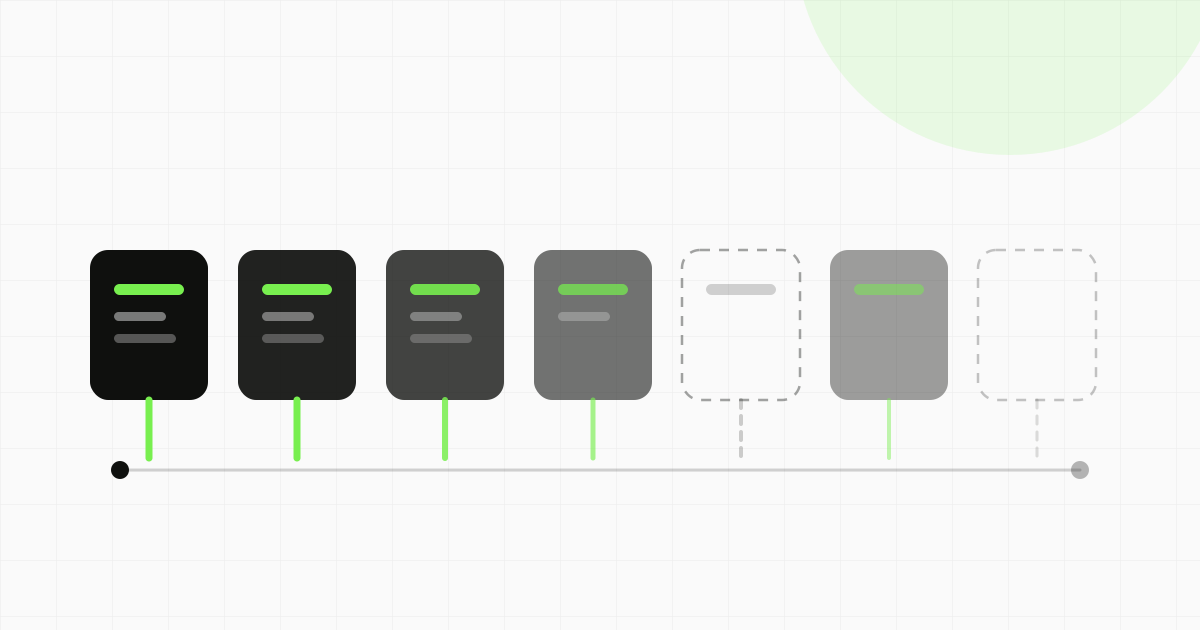
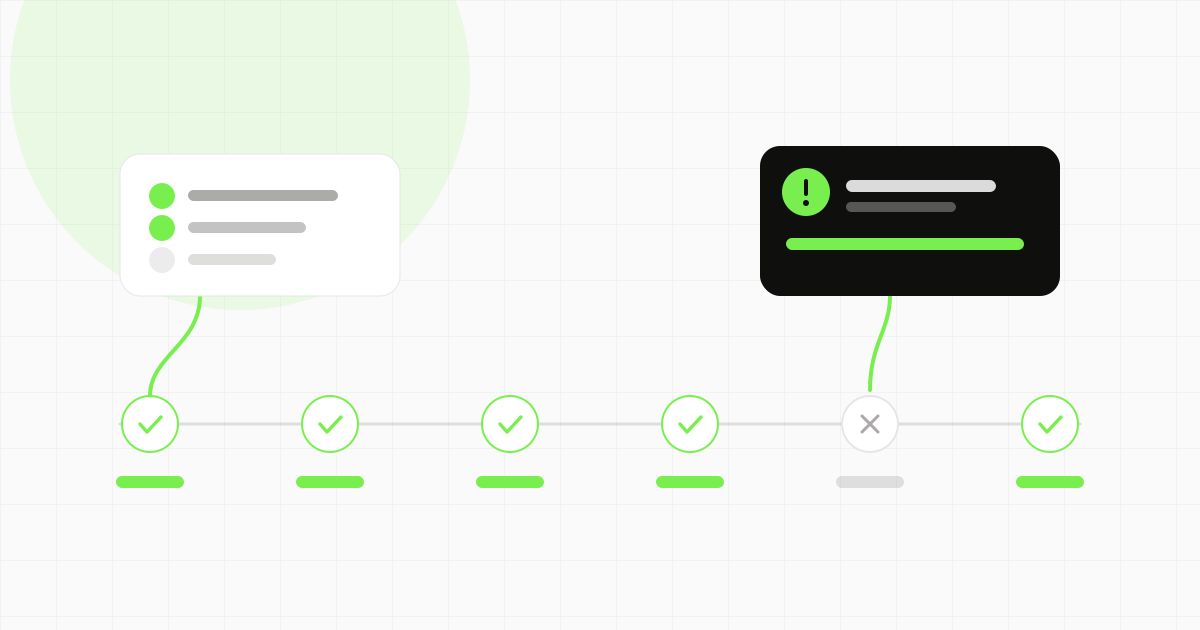
The timeline after booking. Every stage carries its own question, and the purchase answers none of them.
Week 1: what to check right after publication
The first check happens on publication day. It takes a few minutes and decides whether a complaint is still possible.
Four features get held against the order. All four sit in the source code of the page.
Where the link sits on the page
A link inside body text sits in a different context from a link in a list at the foot of the page. Google names that difference in the rater guidelines as a marker of editorial placement.
Three positions turn up regularly in purchased in-content links:
inside the body text, surrounded by sentences that give a reason for the reference
in a box under the heading Advertisement or Partner content
in the comments under somebody else's article
The third one is the weakest. Links in comments rarely carry editorial weight, and many sites output them with nofollow across the board.
A common miss looks like this. The in-content link ordered appears as the last sentence of the article, in the form "you can find more information here".
The better version reads differently. The link sits in the third paragraph, inside the sentence "practices that confirm appointments the day before see fewer empty chairs", and the anchor text names the topic of the landing page.
Which link attribute is set
The attribute sits in the source code on the a tag. Any browser shows it through the developer console.
Three cases are possible. No attribute, rel=nofollow or rel=sponsored.
Which case applies belongs in the agreement before the booking. A provider who states nothing about it leaves open a question Google addresses explicitly in its own documentation.
We show the attribute on every publisher in the marketplace, next to topic, organic traffic, SEO data and price per placement.
Whether anchor text and landing page match the order
The anchor text is the visible text of the link. It passes through several hands while the article is agreed, and editorial feedback changes it more often than buyers expect.
Two deviations turn up regularly. The anchor text was rewritten by the editor, or the landing page was swapped for the home page.
The distribution of anchor texts belongs here as well. A link profile in which twenty purchased placements carry the same money anchor shows a pattern Google lists in the spam policies under optimised anchor text.
The better version is a mix. Brand name, bare URL, topic term and a descriptive half sentence sit next to each other, and the exact money anchor stays the exception.
That mix is worth agreeing before the first booking of a campaign. Once ten placements carry the same anchor, the pattern is already in the link profile.
Whether the page carries a disclosure
Publishers with an editorial standard label their paid articles. The label reads Advertisement, Sponsored, Paid post or Partner content, and it sits above the text.
A missing label is no advantage for the buyer. It moves a risk onto the publisher, and the working relationship is meant to run for years.
Week 2 to 8: the indexing of the placement
An article Google does not hold in its index does not exist for search. The same applies to any judgement about the link.
Why the site test gives no reliable answer
The widespread recommendation is to enter the URL with the site operator into Google search. One result means the page counts as indexed.
Google contradicts that method in its own documentation on the site operator. The page states that the operator does not necessarily return all URLs indexed under the prefix given in the query.
The indexing status of somebody else's domain cannot be measured reliably from the outside. That limitation applies to every provider and to every buyer.
What indicates indexing instead
For your own website Search Console supplies reliable data. For a publisher page three indirect indicators are available:
The link shows up in the backlink profile of your own domain in an SEO tool such as Ahrefs, Semrush or Sistrix.
The page ranks for a literal phrase taken from its own text.
Search Console reports the referring page under the links to your site.
The first indicator is the most usable. A crawler at an SEO tool finds the link independently of Google's index, and the third indicator requires Google's index.
The search for a literal phrase is the fastest test. Put an unusual half sentence from the article in quotation marks, find the page in the results, and the indexing is established.
What a placement without indexing means
A placement showing no sign of indexing after eight weeks has several possible causes. Three of them occur often.
The page can be excluded with noindex. That is visible in the source code and would be grounds for a complaint.
The domain can have dropped out of the index in parts. Other articles on the site are affected as well in that case, which shows up as a fall in its organic traffic.
The page can simply be sitting in the queue. Google indexes articles on rarely crawled domains with a delay.
The second case matters most for the next booking. A domain with falling organic traffic delivers placements that fewer and fewer people see.
Month 2 to 6: persistence, anchor text and silent edits
From the second month the check changes. It now asks whether the placement is still there and still reads the way it did.
The four ways a purchased placement disappears
A purchased link rarely disappears with notice. Four patterns turn up regularly in practice:
The article is deleted and the URL answers with a 404.
The article stays and the link is taken out of the text.
The attribute is set to nofollow after the fact.
The domain changes owner and the inventory gets cleaned up.
The second case stays unnoticed longest without a check. The URL still answers with 200, the screenshot still matches, and the link is gone anyway. The third case is visible only in the source code.
Backlink monitoring exists for exactly these cases. One check per quarter is enough to catch all four patterns.
Rented links and the day the rent stops
Part of the market sells placements on a term. The link stays up for as long as a monthly fee keeps running.
The model is permitted, and some providers describe it openly. It turns into a problem when the buyer does not know about it.
When the term ends, every affected link disappears on the same day. The visibility built on those links goes with them.
The question belongs in every conversation before a booking. It asks whether the link stands permanently or runs on a term.
With us the placement stands permanently. We also check every placement for twelve months on availability, anchor text and indexing.
How anchor texts change after publication
Anchor texts change after publication more often than buyers assume. Two occasions are typical for it.
During a relaunch of the publisher website, old articles move into a new template. Formatting inside the body text is lost occasionally in that move.
During an editorial update, an article gets refreshed. An anchor text is rewritten in the process, and nobody informs the buyer about it.
What a link guarantee covers
A link guarantee is the commitment to restore or replace a failed link within a set period. It is the reason measuring persistence is worth the effort at all.
Three details about it matter before a booking:
What period does the guarantee run for?
Does it cover only the 404 case, or the removal of the link from the text as well?
Does a replacement on a different domain count as fulfilment?
Our check runs for twelve months. If a link fails in that time, we replace it at no extra cost.
Month 3 to 12: the visibility of the placement itself
From the third month the question that sums up all the earlier ones can be asked. It asks whether the page carrying the placement gets read at all.
Organic traffic on the page carrying the placement
The first value is the organic traffic of the publisher page. SEO tools estimate it and label it as an estimate.
Two values need separating here. The traffic of the whole domain and the traffic of the single URL carrying the placement.
The second value says more. A domain with 80,000 visits a month can carry a subpage that gets ten of them.
A negative example from an offer reads "placement on a domain with more than 50,000 visitors a month".
The better version of the same statement reads "the article runs in the practice management section, which gets around 1,900 visits a month from search results, and it stays linked from the newsletter archive for six weeks".
The second wording can be checked before the booking. The first one can be checked after it, and only in parts.
Clicks from the placement to your own landing page
The second value is the clicks that arrive on your website through the link. They sit in the analytics report under referrals.
That number comes out low in almost every case. Double-digit monthly clicks are a good result for a topically fitting placement.
A link without a single click over twelve months describes a page nobody reads.
Comments, shares and other engagement under the article are an additional signal. They show that real readers reach the page.
What your own link profile shows
The third value sits in your own backlink profile. A backlink analysis each quarter shows how the number of referring domains develops.
Three figures are enough for the judgement:
the total number of referring domains
the distribution of anchor texts across all references
the share of references from topically fitting environments
The third figure is where the use of purchased placements becomes readable. It rises only when the choice of publishers matches your own topic.
A ranking improvement cannot be attributed to a single placement. Too many factors act at the same time, from on-page work through the competition to Google updates.
The development across several quarters can be attributed. Fitting referring domains and the visibility of the landing page rising in parallel is the most solid connection available.
How paid placements get disclosed to readers
Google's guidelines cover the attribute on the link. Disclosure to the reader is a separate matter, and it applies whatever the attribute says.
The principle behind disclosure rules for paid articles
The principle is the same across markets. A reader has to be able to tell that a piece was paid for before acting on it.
Where that principle is written into law, the wording differs by country. Advertising standards bodies, consumer protection authorities and press councils each set their own rules for it.
Germany writes the principle into competition law. Section 5a(4) of the German Act against Unfair Competition treats it as unfair to conceal the commercial purpose of a commercial act, where that purpose is not obvious from the circumstances and the concealment can lead a consumer to a decision they would otherwise not have taken.
The duty falls first on the publisher who runs the article. It reaches the buyer indirectly, because a placement without disclosure stays open to challenge.
One jurisdiction is named here on purpose. Anyone booking in the UK, the US or any other market takes the rule of that market and asks the publisher which standard the page follows.
What a disclosure has to look like on the page
Practical requirements for the wording exist as well. The guide to advertising disclosure in online media from the German media authorities covers blogs and other online media according to its own scope.
The guide describes how a label has to be placed and worded. Position, size and clarity of the term decide the outcome.
A negative example from the market looks like this. A paid article carries the note "created in cooperation" in grey type at the foot of the page.
The better version sits somewhere else on the page. The word Advertisement stands above the headline in the same size as the section label, and a line underneath names the company that paid for the article.
That version also meets the criterion Google applies in the example on page 57 of the rater guidelines. The reader sees immediately who is responsible for the content.
The market figures about buying links, fact-checked
No other part of this topic carries as many circulating numbers as prices and adoption do. Almost all of them trace back to a handful of sources.
Those sources mostly fail a check. The finding is uncomfortable and at the same time the most usable information in this article.
"A paid link costs around 361 dollars on average"
This figure appears in advice articles in several languages. It comes from an analysis in which two separate samples were collected.
The first sample covered 450 sites contacted and concerned niche edits, meaning links added to existing articles afterwards. The average price came out at 361.44 US dollars, and only 12.6 per cent of the sites contacted were willing to sell.
The second sample covered 180 sites contacted and concerned paid guest posts. The average price named there was 77.80 US dollars.
The retellings add both samples together to 630 blogs contacted and then take the price from the first sample only. Two formats with very different prices turn into one number that way.
The format most buyers actually book is the paid article. For that format the same analysis names the lower of the two values.
On methodology the author writes that he ran a small study a few years ago. No fieldwork period is stated, and no niches or countries are named.
"74.3 per cent of SEO professionals buy backlinks"
This is the most quoted figure about how widespread link buying is among SEO professionals. Its primary source has redirected to the provider's home page since autumn 2025.
The history can be reconstructed from archived versions of the page. In October 2025 the title carried the year 2025, and in March 2023 the same headline carried the year 2023.
Sample size and methodology section were identical in both versions. It is a single survey from January 2023 at the latest, and its title year was moved forward over several years.
The population was 755 readers of a blog about niche sites. 525 of those readers ran niche sites themselves.
A figure with that population describes one corner of the market. It is quoted as a statement about the whole profession.
"62.5 per cent of agencies charge at least 500 euros"
This figure comes from an analysis of an agency directory published in February 2026. It is presented there as a 2026 study.
The sample is 13 agencies. The individual percentages rest on 8 to 12 answers each.
62.5 per cent of 8 is five agencies. Five responses turn into a percentage with a decimal place that way.
The standard survey series on link building stopped in 2022
A recurring industry survey on link building ran for years, the State of Link Building by Aira. The last edition appeared in 2022, with 270 participants and no stated fieldwork period. No edition exists for 2023 to 2026.
The second finding about it weighs more. That survey never asked about shares of link buying or about prices.
Paid links was one of around 25 answer options to a question about techniques in use. Any price figure attributed to that series is attributed wrongly.
A discontinued report series is a signal in itself. It means nobody in this field measures any more.
What was surveyed after August 2024 comes from sellers
Two newer surveys on the topic exist, both from 2026. Both come from companies that sell placements themselves.
Feature
Survey A
Survey B
published
March 2026
March 2026, updated August 2026
sample
518 SEO professionals
500 SEO professionals
fieldwork period
not stated
first quarter of 2026
recruitment
LinkedIn, ads, email
own customers and partners
region
46.3 per cent Europe
not stated
headline figure
508.95 USD average acceptable price
76 per cent pay 300 USD or more
Both surveys measure willingness to pay. Prices actually paid they do not measure.
Figures like these stay quotable with those two labels attached. Without the labels they describe a market that nobody surveyed.
Neither survey breaks its figures out by country. A buyer in the UK or the US has no national benchmark to compare against.
Five checks for any figure in an experience report
These cases boil down to a short routine. It takes a few minutes per figure:
How large was the sample, and does the number appear in the text?
When was the fieldwork done, rather than when was it published?
Who was surveyed, and how were the participants recruited?
Does the publisher sell the thing it asked about?
Does the link lead to a reachable page where the figure really appears?
A figure that leaves four of these five open carries no budget decision. It works as an opener for a conversation.
What third-party metrics say about a publisher
Offers for backlinks almost always carry a metric in the title. Domain Rating, Domain Authority, Trust Flow or Authority Score stand there as a quality promise.
What the providers write about their own metrics
The limitations below come from the documentation of the providers themselves.
Metric
Calculation disclosed
Limitation stated by the provider
Ahrefs Domain Rating
no
no single DR value can be called good, it is all relative
Ahrefs Organic Traffic
method yes, CTR model no
the values are explicitly estimates
Majestic Trust Flow
no
Google does not use DR, DA or Trust Flow to rank pages
Semrush Authority Score
eight factors named, weighting not
meant for comparing domains, not for an absolute verdict
Sistrix Visibility Index
the most transparent, CTR curve not
not a traffic index and does not want to be one
A simple way to handle them follows from this overview. Metrics work for comparing two publishers and fail as an absolute threshold.
An offer advertising a minimum value sells a number. An offer putting topic, traffic of the actual section and price per placement side by side sells a placement.
What the wording in backlink offers means
Offers for backlinks work with a vocabulary of their own. Premium backlinks, high quality backlinks and strong trust signal stand there for quality.
None of those terms is defined anywhere. Premium usually describes a price tier at the provider and no feature of the placement.
A negative example from an offer reads "10 high quality backlinks from premium domains with a strong trust signal".
The better version of the same promise names features that can be checked. It reads "10 in-content links in trade articles about dental practice management, section traffic between 900 and 3,000 visits a month, link in the body text, attribute stated before booking".
Anyone comparing the merits of an offer translates each advertising term into a stated detail. The chances of a usable placement rise with every detail fixed before the booking.
Google's note on third-party tools
Google comments on these metrics in its own guidance on third-party services. The page states that third-party tools have no access to Google's internal ranking data.
The same page states that Google does not evaluate third-party services. Claims of that kind should be treated with caution according to Google.
A second passage in Google's help belongs here. On participation in an advertising programme Google writes that it affects inclusion and ranking in the search results neither positively nor negatively.
That answers the common equation of paid placement and purchased ranking from Google's own side. What gets paid for is reach, and a ranking does not follow from it automatically.
The three routes to a purchased placement
Anyone sourcing a placement has three routes to choose from. They differ in effort, control and transparency of the price.
Route
What it costs
Where its limit sits
asking website owners yourself
working time, price negotiated case by case
volume, every request is built one at a time
agency or reseller
retainer or package price
how the price is composed stays open
placement marketplace
a fixed price per publisher
the choice is limited to connected publishers
Asking website owners yourself
On the first route a team contacts the website owners itself. It costs no extra money and a lot of working time.
In our experience a placement sourced that way costs about one working day, from research through to sign-off. At twenty placements a quarter the route hits a staffing limit.
Anyone booking through a marketplace runs none of that outreach.
Through an agency or a reseller
On the second route a service provider handles the sourcing. Billing often runs as a monthly retainer or as a package with a set number of links.
With a retainer, the share going to the publisher stays open. Across several reseller stages margins add up that the retainer does not itemise.
The selection criteria for this route are covered in full in choosing a backlink agency. The questions for a first conversation with a provider sit there as well.
Through a placement marketplace
On the third route the team picks the publisher on a platform itself and books directly. Topic, organic traffic, SEO data, link attribute and price per placement sit visibly side by side before the booking.
GetMentioned is a link building agency with its own placement marketplace. Full service in link building, not full-service SEO.
The price you see in the marketplace is the price you pay. There is no subscription, no base fee and no minimum order.
Teams that want to hand the sourcing over get it from us as a managed engagement. We take on link gap and landing pages, publisher research, the text, publication, monitoring and reporting.
We do not work on the website itself. Site structure, technical SEO and content planning for your own domain stay with you or with whoever handles your search engine optimisation.
The limit sits in the selection. A marketplace carries connected publishers only, and a very specific topic finds fewer options there than a broad one.
Which projects purchased placements are worth it for
Purchased placements are worth the effort where revenue, ranking potential and a gap in the link profile meet on the same page. A brand's presence online does not grow with every purchased link.
Typical situations from practice
We see the same starting points again and again in practice:
A revenue-relevant landing page has sat between position 6 and 20 for months.
Competitors on the same topic have more referring domains from fitting environments.
A new topic cluster needs authority so its pages enter the assessment at all.
The brand does not appear as a source in AI answers on its own topics.
A team bought placements and never checked whether they still stand.
For SEO teams the control over landing page and anchor text counts in these situations. For marketing leads it counts whether the build turns plannable and budgetable.
For founders and management a third question counts. It asks what output arrives per quarter and how much internal working time it takes.
When the budget moves more somewhere else
Some starting points leave little for purchased placements to move. Three of them occur often.
A landing page without ranking potential does not rise with references either. A page missing the substance on its topic is missing the basis for the ranking.
A website with serious technical problems benefits from fixing those first. On-page work and load time act faster there than link acquisition does.
A project without defined landing pages spreads its references evenly over the home page. The use of them stays diffuse in that case.
Buying links is therefore no shortcut around search engine optimisation. It is the part of a backlink strategy that works once content and technology are in place.
Conclusion: what is left of a purchased placement after a year
Buying backlinks is permitted according to Google's own documentation, as long as the link carries an attribute. The line runs at the ranking credit a link passes.
The second line sits in the rater guidelines. With no topical fit between content and publisher, Google rates the page Lowest even when the labelling is correct.
That puts the question about the topic ahead of the question about the metric. It also puts it ahead of the question about the price.
Experience reports help little with that decision, because they end on publication day. Indexing, persistence, anchor text and the visibility of the page carrying the placement decide the outcome.
Those four values can be measured. A few minutes per placement per quarter is enough for it.
Frequently asked questions
Is it allowed to buy backlinks?
Google explicitly permits the buying and selling of links when the link carries rel=sponsored or rel=nofollow. Without that attribute a paid link falls under Google's definition of link spam. Disclosure to readers is set by each market, and in Germany section 5a(4) of the Act against Unfair Competition requires the commercial purpose to be made recognisable.
What happens when Google detects a purchased backlink?
Google names two possible consequences in the spam policies. A site may rank lower or stop appearing in the results at all. With a manual action a message arrives in Search Console, and the fix requires demonstrable efforts to have the links removed.
How long does it take for a purchased placement to be indexed?
No general figure exists, and the indexing status of somebody else's domain cannot be measured reliably from outside. A search for a literal phrase from the article serves as an indicator. With no sign after eight weeks, check the source code for noindex.
How many purchased backlinks are still live after twelve months?
No solid survey exists on that, in any market. What can be measured is your own inventory through a quarterly link monitoring. Four patterns occur, namely a deleted article, a removed link, a nofollow added later and a change of domain owner.
How do I tell whether an experience report about buying links is any good?
Check the publication date against the date of the booking it describes. Less than a year between the two means the report describes the purchase and not the outcome. Check as well whether it names the linked page and whether the author sells placements.
Are expensive backlinks better than cheap ones?
The price follows the reach, the topic and the demand of the publisher, and it describes no quality. The organic traffic of the section, the topical fit with the landing page and the position of the link in the text say more.
What does a placement at GetMentioned cost?
Every publisher has a fixed price per placement that is visible before you book. The price you see in the marketplace is the price you pay. There is no subscription, no base fee and no minimum order.
David has been building link acquisition and digital PR processes since 2016, first as an agency under SEO Galaxy, today as a platform with GetMentioned. He has scaled his own projects from zero to seven-figure monthly traffic and delivered thousands of campaigns for clients. Here he writes about what works in practice, and about what only costs budget.
Your next link does not have to be a blind buy
Compare publishers, SEO data and prices in one place and book the placements that fit.
Top-10 lists do not help with this decision because they answer the wrong question. Provider models compared, five levels of scrutiny and four steps from enquiry to contract.
How search engines and AI systems weigh links, which methods exist, what link building costs and how paid placements should be judged. The overview, with pointers into the detail.
A link you built is not a possession. How ongoing monitoring works: what gets watched, how often, which alerts make sense and what belongs in reporting.