LLM visibility: what the model knows and what it looks up
A brand surfaces either from model weights or from a web search at runtime. A half-hour test separates the two, and that decides whether the work takes days or months.
LLM visibility describes how visible a brand is in the answers of large language models such as ChatGPT, Gemini, Claude and Perplexity.
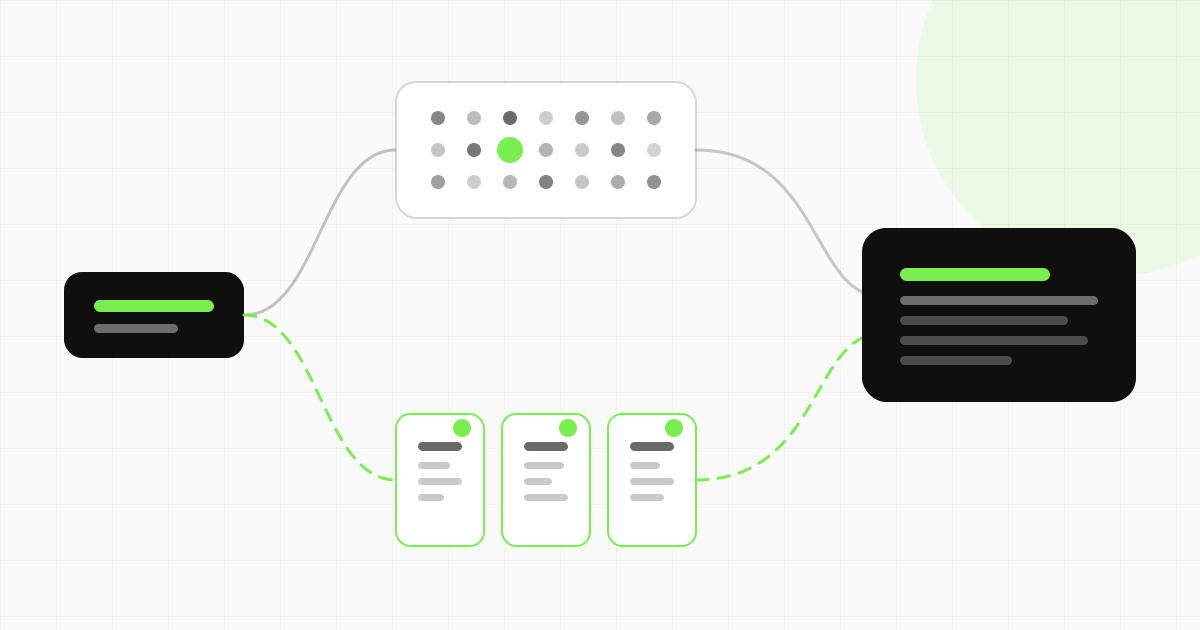
A brand can reach an answer by two entirely different routes. Both feel identical to the reader. For the work behind them they are not.
What LLM visibility describes
The term describes an observation. You put questions to a system and record whether your brand comes up, in what context and beside which competitors.
The usual definition stops at that count. It says nothing about where the mention came from.
That is the piece every action depends on. Without it you watch a number without knowing what moves it.
The two routes into an answer
The route through model weights
A language model absorbed text during training. Whatever appeared there often and consistently, it can reproduce without looking anything up.
That knowledge sits in the model weights. It is either there or it is not.
It changes only when a new model is trained. That happens on a scale of months.
The route through web search
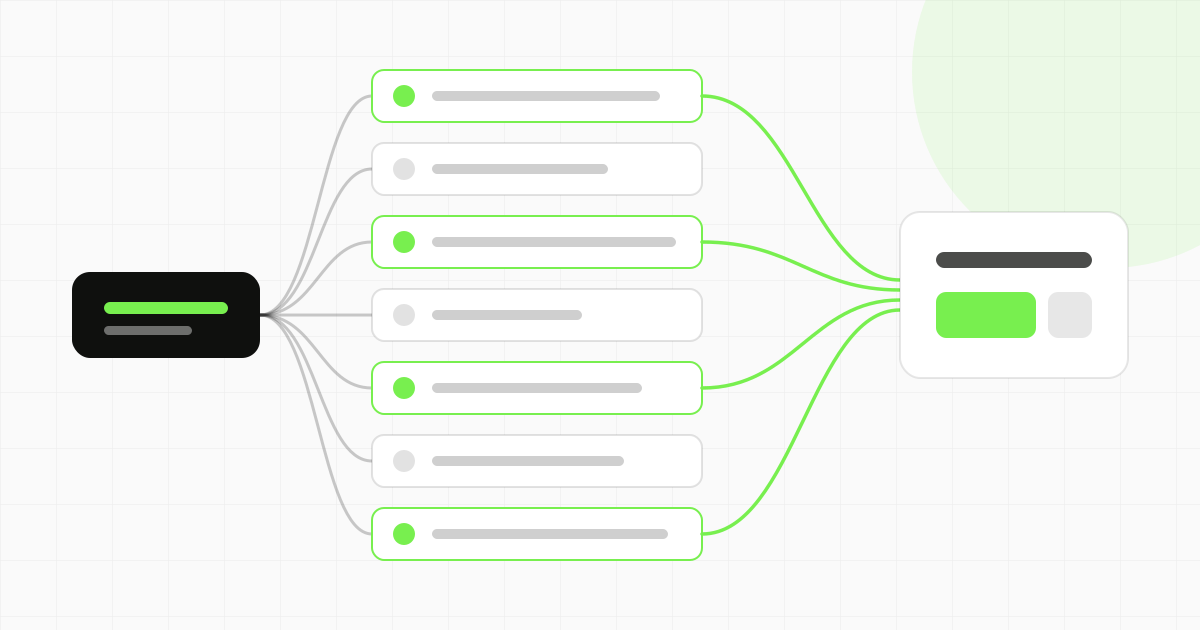
Most systems can look things up at runtime. They pull a few pages, read them and assemble the answer from those.
This route is called retrieval. Google calls it grounding, an umbrella covering several methods, retrieval-augmented generation among them.
What counts here is the current state of the web. A new page can show up in answers within days.
Why the distinction is not academic
Timing hangs on the origin. A retrieval gap can be closed in a week. A gap in model knowledge persists until the next training run.
Ownership hangs on it too. One route is work on your own site. The other is work on what others write about the brand.
In our experience projects work the first route and measure the second. Then the number refuses to move and nobody understands why.
The cutoff date the vendors publish
Anthropic publishes two dates per model
Anthropic lists two separate values in its model overview. A "reliable knowledge cutoff" and a "training data cutoff".
A footnote defines both. The first marks the date through which the model's knowledge is most extensive and reliable. The second marks the broader range of training data used.
For several models these lie months apart. Claude Sonnet 4.6 shows August 2025 against January 2026.
That is vendor evidence for something usually only assumed. Training data thins out towards the end of a run. A model knows the final months before its cutoff less well than one number implies.
Google publishes none on the model page
The Gemini API model overview lists current models with names, endpoints and short descriptions. No cutoff date appears there.
One value appears only in the Gemini 3 developer guide, given as January 2025. For the newer Flash models we found no official statement.
Asking the model is not a source
The obvious move is to ask the model directly. The result is unreliable.
There are documented cases of a model stating a cutoff that differs from its own vendor's documentation. The answer in chat is itself a model output, with the same failure modes as any other.
The documentation is what holds.
The test: the same question twice
The practical core of this article is a comparison anyone can run.
Asking the same question with and without web search shows which of the two routes carries the mention. The origin decides how long the work takes.
What to prepare
You need a handful of questions with no brand name in them. The questions a prospect asks before they know the vendors.
An example of an unbranded question: "Which companies place expert articles in trade publications in the UK?"
Plus a fresh chat with no history. Memory and personalisation distort the comparison.
How to switch search off
In Claude a web search toggle sits in the input field, per conversation. On Team and Enterprise plans an owner must enable it first.
In ChatGPT web search can be switched off in settings and back on per request via the composer button.
In Perplexity the "Writing" focus mode turns off live search in the web app. Over the API the parameter is disable_search.
For the Gemini interface we found no documented switch. Over the API it is trivial, since you just omit the search grounding tool. In the consumer interface the test cannot be run cleanly.
How to read the result
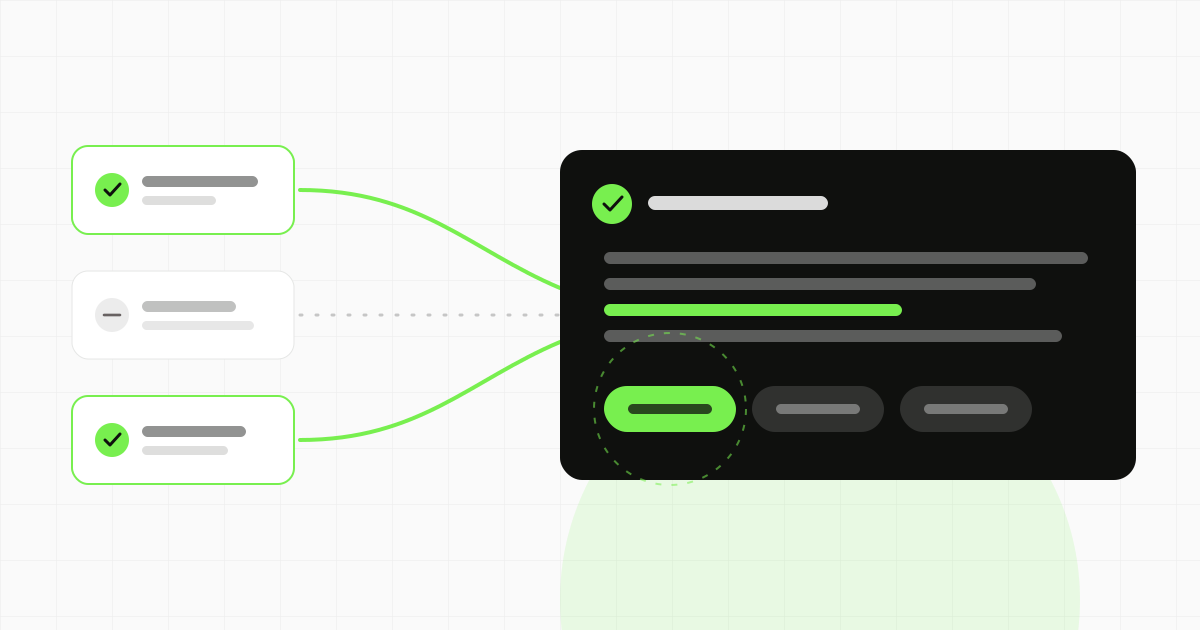
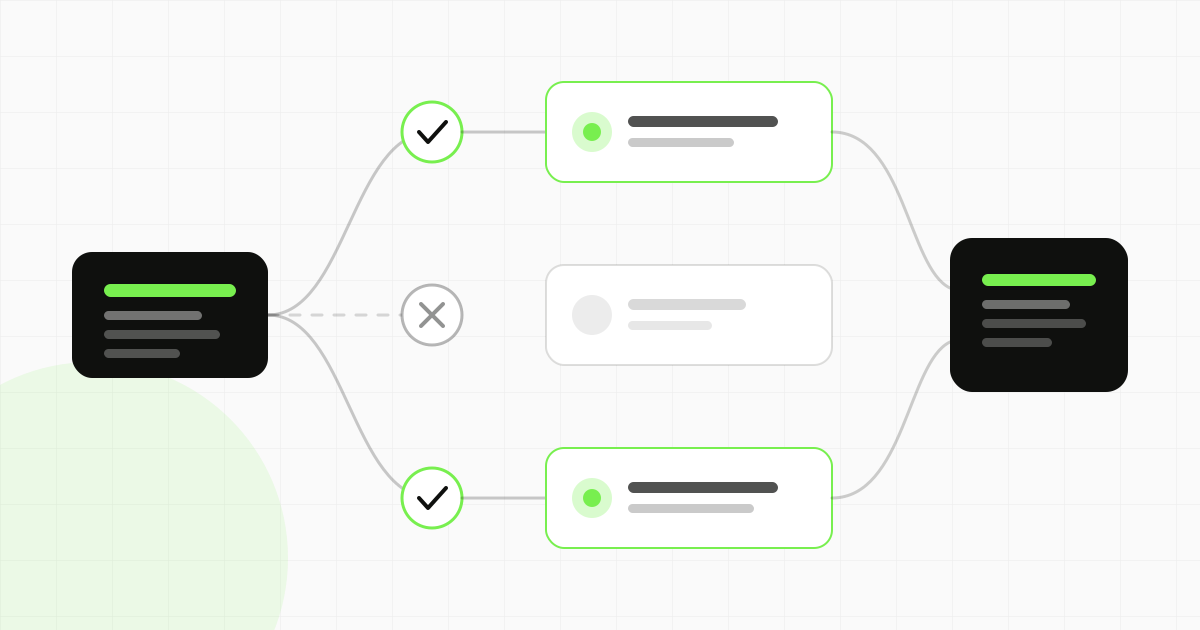
Four outcomes are possible.
Without search
With search
Reading
mentioned
mentioned
Both routes are working
not mentioned
mentioned
Retrieval carries it, model knowledge does not
mentioned
not mentioned
Model knowledge carries it, the web evidence is thin
not mentioned
not mentioned
There is nothing to draw on either way
The second case is common for younger brands. The third turns up with brands that were prominent earlier and whose evidence has aged.
What the test does not separate
With search off you still are not measuring raw model weights. The vendor's system prompt, stored memories and safety tuning sit in between.
So the test gives an approximation. For whether anything sits in the model at all, that is enough.
How often to measure
Once is not enough. The same question draws different answers even in the same moment.
How many runs a defensible statement needs, and what variance is normal, is covered in the article on prompt tracking.
What classic rankings have to do with it
The figures for AI Overviews
In March 2026 Ahrefs analysed where URLs cited in AI Overviews come from, across 863,000 search result pages and four million cited URLs.
Around 38 per cent of citations came from the first ten organic results of the same search. A year earlier it was near 76 per cent.
That shift is placed in context in the article on generative engine optimization.
The figures for the assistants
For the standalone assistants the link is weaker still. In July 2025 Ahrefs put 15,000 long-tail queries to ChatGPT, Gemini, Copilot and Perplexity, then matched the cited URLs against their Google position.
Only 12 per cent of cited URLs ranked in Google's top 10 for the same query. Eighty per cent did not rank for it at all.
The spread is wide. Perplexity reached 28.6 per cent overlap, ChatGPT, Gemini and Copilot each near 8 per cent.
One practical consequence follows. A good position is a weak indicator of whether an assistant will cite the page.
How reliably the systems attribute sources
Anyone measuring LLM visibility is reading the output of a system that demonstrably gets attribution wrong. That belongs in every figure.
The Tow Center study
In March 2025 the Tow Center for Digital Journalism at Columbia University tested eight generative search tools. Twenty news organisations, ten articles each, 1,600 queries.
The systems were given verbatim excerpts from real articles and asked to name headline, publisher, date and URL. An ordinary Google search returns those excerpts in the top three results.
More than 60 per cent of answers were wrong, from 37 per cent at Perplexity to 94 per cent at Grok-3.
The confidence was striking. ChatGPT Search misattributed 134 of 200 articles while signalling uncertainty just 15 times.
The EBU and BBC study
In October 2025 the European Broadcasting Union and the BBC measured more broadly. Twenty-two public media organisations, 18 countries, 14 languages, over 3,000 answers, assessed by working journalists.
Forty-five per cent of answers had at least one significant issue. Thirty-one per cent showed serious sourcing problems, so missing, misleading or incorrect attribution.
Gemini reached 76 per cent, more than double the others according to the report, largely on sourcing.
What that means for measurement
A cited source is not a verified source. Anyone analysing which pages a system cites should spot-check them by hand.
The Tow Center figures are 17 months old and cover superseded models. The order of magnitude still stands.
What can actually be worked on
On the retrieval side
Work here lands quickly and rests on solid evidence. The systems need pages from which single statements can be lifted cleanly.
A maintained, dated page carrying your own key facts is the most direct lever. The article on the grounding page shows what it looks like.
On top sits the question of which crawlers are let in at all, covered in the article on AI search optimization.
On the model side
Here the evidence thins out, and that deserves saying.
What a model absorbs depends on the text sources such models are typically trained on. Nobody has direct access to those.
The plausible route runs through broad, independent mentions over time. Proof that more mentions lead to more frequent mention by the model does not exist.
What the research supports, and what it does not
For factual knowledge about entities, it is well established that models get less reliable on rarely represented ones. Kandpal and colleagues showed this in 2023 on open corpora, He and colleagues in 2025 by counting frequencies in Dolma.
Three limits come with that.
First, these studies measure accuracy on questions with one correct answer. None measures whether a model volunteers a brand unprompted.
Second, the counting only works on open corpora. For GPT, Claude and Gemini it is impossible in principle.
Third, there is a counter-finding. Chang and colleagues showed in 2024 that models trained on duplicated data forget faster. More occurrences do not translate linearly into firmer grounding.
The leap from "answers factual questions less well" to "mentions the brand less often" is plausible and unproven. We treat it as exactly that.
What does not survive checking
For this article we checked the seven metrics an SEO tool put forward as information to cover. None held up. Four sources sit behind the seven claims.
Two figures that contradict each other
"89 per cent of brands already appear in AI search results" and "only 14 per cent have tracking" come from one survey of 100 self-reported responses.
The logical break is in plain view. If 14 per cent measure, nobody can know that 89 per cent appear.
The source also says 14 per cent of marketers, not of brands.
An expired forecast in two disguises
"25 per cent decline in search volume by 2026" is a Gartner forecast from 19 February 2024. The deadline passed and the decline did not happen. StatCounter puts Google's worldwide search share at 91.31 per cent for July 2026.
"AI answers capture 25 per cent of search traffic" is the same number reversed. A forecast decline in volume differs from traffic captured.
The full treatment of that forecast sits in the article on generative engine optimization.
The range of 20 to 50 per cent by 2028, often quoted beside it, comes from McKinsey. There it applies explicitly to unprepared brands.
An invented position threshold
"AI models pull from position 21 and below" matches no measured quantity. Ahrefs measures the bands top 10, 11 to 100 and beyond 100.
The underlying point is better supported than the claim suggests. Only the threshold is invented.
The figure "40 per cent increase in AI share of voice" could not be traced to any study.
The usable news is in the test itself. What a model looks up, you can change this week. What it learned, not before the next training run.
David Hahn, Managing Director at GetMentioned
Conclusion: establish the origin, then act
LLM visibility is one number with two causes. While it is unclear which is at work, every measure is guesswork.
The test costs half an hour. Ask the same unbranded question with search off and on, in a fresh chat, several times over. The answer tells you whether the work sits on your own site or on what others write about you.
In practice we see the second gap more often. It is the more awkward one, because it cannot be closed inside your own CMS.
Frequently asked questions
What is LLM visibility?
How visible a brand is in the answers of large language models. It measures whether and how a brand is named, in what context and alongside which competitors.
What is the difference between LLM visibility and AI visibility?
The terms overlap heavily. AI visibility covers building and measuring visibility in AI search systems. This article covers the prior question of whether a mention comes from model knowledge or from a web search.
How do I find out whether a model knows my brand on its own?
Ask the same question once with web search off and once with it on, in a fresh chat with no history. If the brand only appears with search enabled, there is nothing in the model knowledge.
Why does a model not know my company even though we rank well?
Ranking and citation are linked more weakly than assumed. In an Ahrefs analysis from July 2025, only 12 per cent of URLs cited by AI assistants ranked in Google's top 10 for the same query.
What is a knowledge cutoff?
The date up to which a model's training data runs. Anthropic publishes two values for this, one for reliable knowledge and one for the broader data range. They can lie months apart.
How quickly does a change to my own website take effect?
On the retrieval side within days to weeks, once the page has been fetched and taken into the relevant system's index. On model knowledge, at the earliest with the next training run.
Are unlinked mentions useful for LLM visibility?
For the retrieval route what counts is that a fetchable page carries the statement. A link is not a condition for that. For the model knowledge route there is no solid evidence either way.
Can I trust the systems when they name a source?
Only with spot checks. In an EBU and BBC study from October 2025, 31 per cent of the answers reviewed showed serious sourcing problems.
David has been building link acquisition and digital PR processes since 2016, first as an agency under SEO Galaxy, today as a platform with GetMentioned. He has scaled his own projects from zero to seven-figure monthly traffic and delivered thousands of campaigns for clients. Here he writes about what works in practice, and about what only costs budget.
Your next link does not have to be a blind buy
Compare publishers, SEO data and prices in one place and book the placements that fit.
AI answers recommend providers before anyone clicks a ranking. How to measure AI visibility, which signals carry it, and where the external evidence models lean on comes from.
The same question returns different answers at the same moment. What a measurement setup that survives this looks like, and why numbers from two tools cannot be compared.
Every AI system runs its own crawlers, and each has a different job. Why the widely repeated advice about Google-Extended does not work, and what Google and Microsoft actually ask for.