AI Mentions: How Brands Become Visible in AI Answers
Whether a brand appears in answers from ChatGPT, Perplexity or Gemini can be measured. How AI Mentions come about, which KPIs matter and what repeatable monitoring looks like.
When people ask questions today, they land on Google directly less and less often, and increasingly they go first to ChatGPT, Perplexity, Gemini, Claude or Meta AI. The consequence: visibility is shifting away from classic search results and towards answers.
Anyone who does not appear in those answers loses relevance, clicks and ultimately revenue. This is exactly where AI Mentions come in: measurable mentions of your brand in AI answers, including context, competitive environment and source situation.
In this article I show you how to understand, measure and actively influence AI Mentions, and why you need more than just "good content" and a few links to do it.
What AI mentions are and what they reveal
AI Mentions are mentions of a brand, website, person, product or company in AI-generated answers. They show whether AI systems consider your brand at all on relevant questions, for example as a provider, source, expert voice or recommendation.
For companies, AI Mentions are becoming increasingly relevant because they make visibility in AI answers measurable. Brand mentions already appear in a growing share of AI answers and influence attention, trust and demand, even when no direct click on the website follows.
Understanding AI Mentions: Context, Accuracy & Competitors
AI Mentions are more than an AI version of classic mentions. In search, the user decides which result to click.
In Answer Engines, the model decides which brands it mentions in the first place. You are no longer competing only for rankings, but for inclusion in the AI answer itself.
Three dimensions are central for assessing your AI Visibility:
Context: in which questions do you show up, only on generic queries or on transactional prompts as well? This analysis shows you where your Visibility Layer has gaps.
Accuracy: AI can hallucinate when the underlying evidence is weak or contradictory. Wrong prices, services or positioning turn into a revenue and reputation risk.
Competitive environment: what counts is not only whether you show up, but also next to whom. Systematic analysis of AI Mentions shows how AI systems file you within the competitive field.
If you want to know whether and how your brand appears in AI answers today, start with a small AI visibility audit: 20–30 defined prompts, 3 systems (e.g. ChatGPT, Perplexity, Gemini), a clear evaluation by context, accuracy and competitors.
Comparison: AI Mentions vs. Classic SEO Ranking
Classic SEO ranking AI Mention Position in search results Mention in AI answers URL is at the centre Brand, entity and context are at the centre Measurement per keyword Measurement across Prompt Sets (intent clusters) Click path relatively clear Answer context, sources and attribution more important Focus on SERP position Focus on mention, description, sentiment, competitors
AI Mentions vs. Classic Mentions: Brand Mentions, SEO Rankings, AI Citations
Classic mentions (Brand Mentions) and SEO rankings remain important, but they fall short when you want to understand how LLMs (Large Language Models) make decisions.
In the world of AI Mentions, signals merge into a shared visibility profile. Brand Mentions on websites, in media, industry directories or forums send the message: "This entity exists and is linked to topic X."
Citations (e.g. structured directory entries) reinforce that message. SEO rankings show relevance in SERPs, but AI Mentions show whether the model even "thinks" of you as part of the answer.
Answer Engines & AI Systems: ChatGPT, Perplexity, Gemini, Meta AI
Answer Engines such as ChatGPT, Perplexity, Gemini or Meta AI turn search queries into complete answers. They use different data sources and mechanics: Perplexity works strongly source-oriented, Gemini is closely tied to the Google ecosystem, ChatGPT combines training data and (depending on the mode) web access.
That is why you should evaluate AI Mentions separately per AI system and prioritize your levers (sources, formats, publishers) per system.
Building a Visibility Layer: Signals AI Really "Believes"
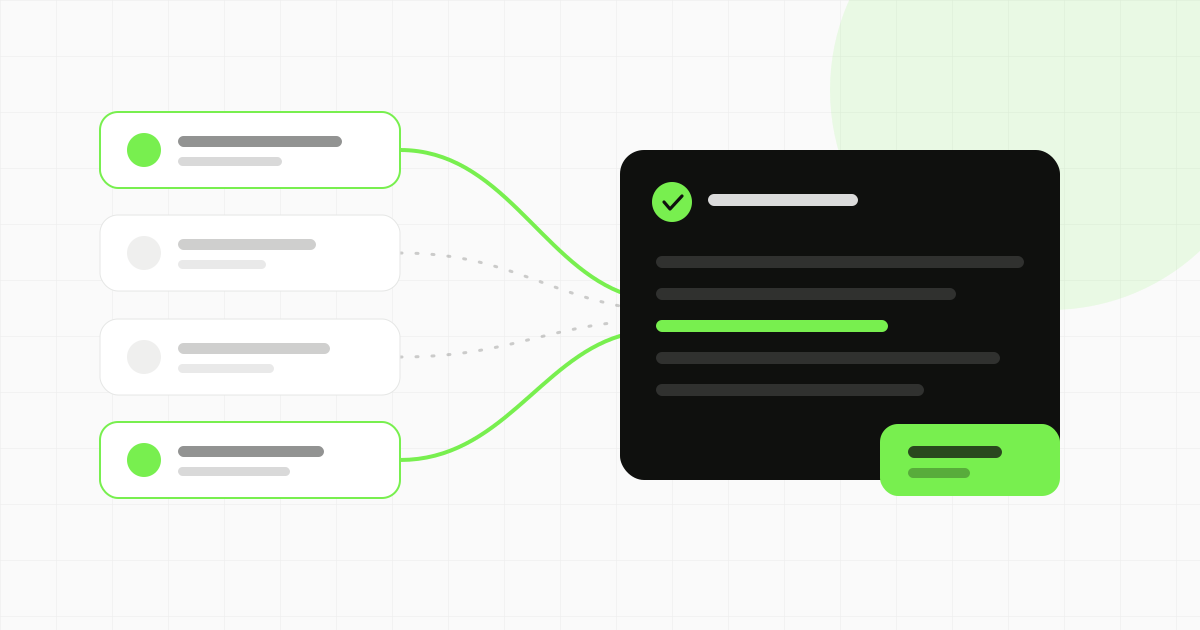
The Visibility Layer is the sum of all digital evidence that AI models use to decide whether your brand is relevant: content, structured data, company profiles, reviews, topical backlinks, interviews, studies, industry listings.
Many companies produce strong content, but the signals stay inside their own ecosystem. For AI Mentions you need recurring evidence across different hosts, domains, formats and contexts.
At the same time: reduce noise. Arbitrary mentions on irrelevant pages create scatter.
Discovery Channels & Topical Authority: From Content to Market Evidence
Discovery in AI systems happens through Discovery Channels: search indexes, trade media, databases, directories, review portals. Topical Authority is the foundation, but it has to be reflected as market evidence (independent sources confirm you).
A workable route: start with core topic clusters and derive external placements from them (trade articles, interviews, case studies, data points). That is how your Visibility Layer becomes denser.
This is exactly the external evidence you build up predictably with GetMentioned: you find fitting publishers, compare SEO data, prices and quality, and book Brand Mentions, guest articles and PR placements directly. MentionIQ analyses your website, your competitive environment and your most important keywords for this and proposes the placements with the presumably highest impact.
For years an unlinked mention counted as worthless. That assumption was mostly convenient, because it was easy to measure.
David Hahn, Managing Director, GetMentioned
Measuring AI Mentions: Prompt Monitoring, KPIs and AI Tools
At the core is repeatable prompt monitoring: defined Prompt Sets per intent (Learn, Compare, Decide, Do) and per system (ChatGPT, Perplexity, Gemini).
AI tools help here with automation (capture, parsing, entity extraction, dashboarding). For consolidating mentions and contexts across several channels there are specialized AI visibility and GEO tools such as Mentions.so, peec.ai or Rankscale.
What remains decisive, though, is your own prompt set design and your evaluation logic.
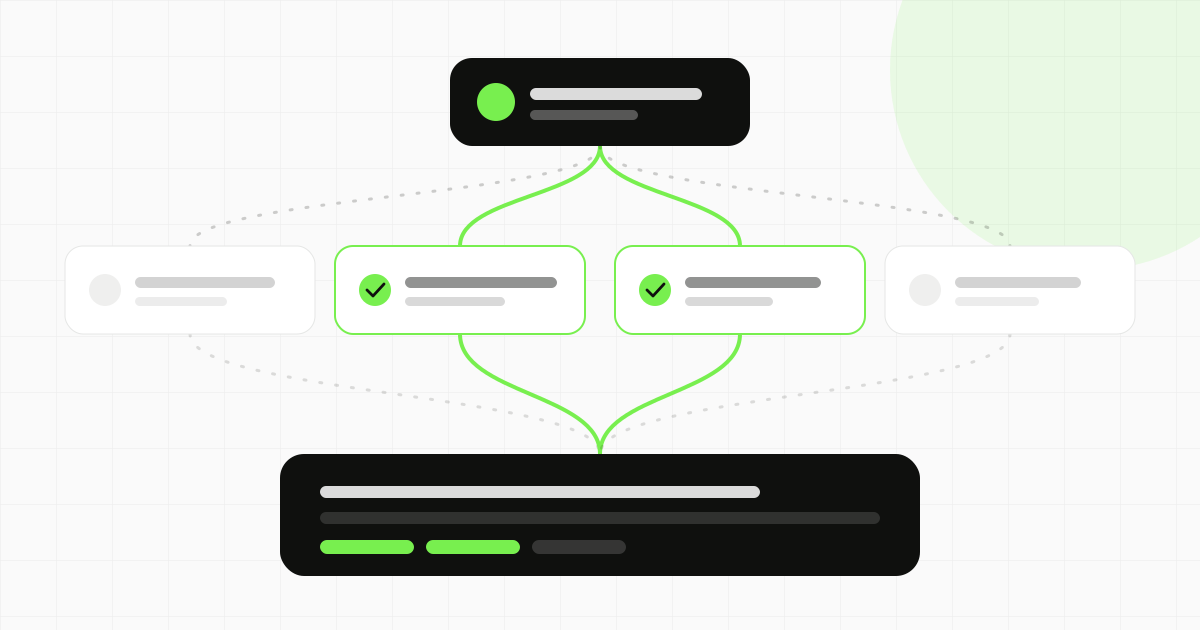
The seven steps interlock: the evaluation of one round shapes the prompt set of the next.
Which KPIs Show the Success of AI Mentions?
AI Mentions should never be judged by a single metric. Only the combination of visibility, context quality, competitive comparison and business signals shows whether your AI Visibility is actually improving.
KPI
What it tells you
AI Mention Rate
How often your brand appears in relevant AI answers
Share of Voice in AI
Your share of mentions compared to competitors
Share of Model
Visibility per model, for example ChatGPT, Gemini, Perplexity
Prompt Coverage
For how many relevant prompts your brand gets named
Sentiment
Whether AI systems describe your brand positively, neutrally or negatively
Context Accuracy
Whether services, categories and positioning are represented correctly
Competitor proximity
Which competitors your brand is named alongside
Source coverage
Which sources and publishers are connected to your mentions
How to Track Your AI Visibility: Monitoring Table
Prompt
Named?
Context
Sources
Accuracy
Next action
Which tools help with AI visibility monitoring?
Yes
Comparison
Trade articles, vendor lists
Partly correct
Sharpen the feature page
Which providers support LLM SEO?
No
Vendor recommendation
Publisher articles
Not relevant
Build source coverage and comparison content
What is Generative Engine Optimization?
Yes
Definition
Guides
Correct
Expand the topical cluster
7-step workflow: from analysis to optimization
To turn tracking into a scalable process, you need a clear sequence of analysis, assessment and derivation of measures.
Define relevant topics and use cases.
Build the prompt set, grouped by intent clusters: Identify, Compare, Decide, Learn, Do.
Capture AI Mentions: mentions, non-mentions, competitors, sources, context.
Assess quality: accuracy, context fit, sentiment, position in lists.
Analyse the source situation: which sources dominate the answers?
Repeat the monitoring and track trend, Share of Voice and Share of Model.
If you do not want to run this process manually, set it up as a fixed monthly rhythm: Prompt Sets, evaluation and action plan. That way AI Visibility becomes a repeatable system instead of sporadic tests.
Build a repeatable content and evidence pipeline out of your findings, one that positions your brand lastingly as a relevant source for AI search.
AI Visibility Checklist
Do I have a fixed prompt set per topic/intent?
Do I track AI Mentions per system (ChatGPT, Perplexity, Gemini, Meta AI)?
Do I assess context, accuracy, competitors and sources (not just "named/not named")?
Do I have clear entity signals (name, claim, product category, structured data, consistent profiles)?
Am I building Topical Authority in clusters (instead of single articles)?
Do I have recurring Brand Mentions in relevant, trustworthy sources?
Am I reducing noise (irrelevant or low-quality mentions) in favour of high-quality evidence?
Do I have a backlog of measures that comes directly out of monitoring results?
Quality Assessment: Source Trustworthiness, Attribution & Sentiment Analysis of Mentions
Not every AI Mention is a win. These three aspects are decisive:
Source trustworthiness: authoritative trade media, industry portals, reputable directories and heavily referenced articles act as trust anchors. Low-grade sources create noise rather than evidence.
Attribution: is your brand assigned clearly and correctly to an entity (name, company, product, URL)? Unclear attribution leads to confusion, diluted USPs and wrongly assigned services.
Two fundamentals are central for clean mention tracking: entity recognition (Named Entity Recognition = NER) and coreference resolution (Co-reference Resolution).
NER identifies brands, products and organizations as entities. For you that means: consistent spellings, structured data and unambiguous profiles increase the likelihood that models recognize your brand reliably.
Coreference resolution connects indirect references ("the provider", "the platform", "they") back to the original entity. Many AI answers name you once and then keep referencing you implicitly, and without coreference logic you underestimate your actual AI Mentions.
Mention normalization also plays a role on top of that: map variants onto a canonical name (abbreviations, typos, old brand names, product lines). That reduces duplicates and makes reports more robust, especially when you are comparing several sources, languages and systems.
Evaluating AI Mentions Correctly and Avoiding Wrong Decisions
Many companies focus on the sheer number of AI Mentions and overlook the actual quality factors.
Mistakes you should avoid:
Evaluating AI Mentions without context, sources or competitive environment
Equating AI Mentions with classic Brand Mentions
Missing entity signals, topic clusters or brand positioning
Thin content without clear expertise and differentiation
Too little external evidence through sources, citations and trustworthy mentions
No regular prompt monitoring and no competitive analysis
Outdated or incorrect statements about your own brand
Judging success exclusively by direct clicks instead of by visibility, demand and market presence
Conclusion: AI Mentions as a Measurable Lever for AI Visibility
AI Mentions make visible how AI systems understand your market and what role your brand plays in it. Anyone who does not measure and steer here leaves Answer Engines in charge of interpreting their positioning.
Anyone who actively builds the Visibility Layer, by contrast, makes AI Visibility predictable.
The route there: Topical Authority + high-quality external evidence (Brand Mentions, citations, PR placements) + consistent entity signals + repeatable monitoring across Prompt Sets and KPIs. That way you know whether you appear in relevant answers, whether the information is correct and whether you show up in the right competitive environment.
Frequently asked questions about AI mentions
What Are AI Mentions?
AI Mentions are mentions of your brand in answers from AI systems such as ChatGPT, Perplexity, Gemini or Meta AI. They cover explicit namings as well as implicit references that point unambiguously to your entity. That makes AI Mentions a core indicator for visibility in Answer Engines.
How Can I Measure AI Mentions?
With standardized Prompt Sets (per intent and topic cluster), regular repetition, documentation of the answers and evaluation by brand named, context, position, competitors, sources and accuracy. AI tools for automation help on top of that. Your own quality assessment should always remain part of the process, though.
How Do I Get More AI Mentions?
By building Topical Authority, placing external Brand Mentions and citations in trustworthy Discovery Channels, reducing noise and ensuring consistent entity signals (structured data, consistent profiles, clear positioning). After that you iterate on the basis of your prompt monitoring.
Is Every AI Mention Positive?
No. What is decisive is context, accuracy, sources and competitive environment. An incorrect or unsuitable mention can be just as problematic as no mention at all.
Are AI Mentions the Same as SEO Rankings?
No. SEO rankings refer to positions in search engines, AI Mentions to mentions within AI-generated answers. Both signals can influence each other, but they measure different forms of visibility.
What Is the Difference Between AI Mentions and Brand Mentions?
A brand mention is the mention of a brand on websites, in media or other external sources. AI Mentions arise in answers from AI systems and are frequently influenced by such external signals.
What Role Does Topical Authority Play?
Topical Authority helps AI systems connect your brand with certain topics and use cases. The stronger that topical assignment is, the higher the likelihood of relevant AI Mentions can be.
What Role Do External Sources Play?
External sources supply AI systems with additional evidence about your brand. Recurring mentions in trustworthy environments in particular strengthen the likelihood of being considered in AI answers and recommendations.
Which KPIs Make Sense for AI Mentions?
Sensible metrics are AI Mention Rate, Share of Voice, Prompt Coverage, Sentiment, source coverage and Context Accuracy. For B2B companies, monthly monitoring of these values is advisable.
David has been building link acquisition and digital PR processes since 2016, first as an agency under SEO Galaxy, today as a platform with GetMentioned. He has scaled his own projects from zero to seven-figure monthly traffic and delivered thousands of campaigns for clients. Here he writes about what works in practice, and about what only costs budget.
Your next link does not have to be a blind buy
Compare publishers, SEO data and prices in one place and book the placements that fit.
GEO targets being named in an AI answer rather than a position in the list of results. What is evidenced, which levers work and what the circulating figures are worth.
AI answers recommend providers before anyone clicks a ranking. How to measure AI visibility, which signals carry it, and where the external evidence models lean on comes from.
A brand appears in an AI answer with no source attached. Four different cases carry the same name, and only three of them concern brand visibility. What the studies measure and how the gap can be closed.