Generative Engine Optimization: What Actually Gets Cited in AI Answers
GEO targets being named in an AI answer rather than a position in the list of results. What is evidenced, which levers work and what the circulating figures are worth.
Generative Engine Optimization, GEO for short, is the work of getting content to appear in the answers of generative systems: in ChatGPT, Perplexity, Gemini, Copilot, the AI Overviews and Google's AI Mode. The goal is a mention in an answer, as a source, as a provider or as evidence.
The term comes out of a paper by Aggarwal and colleagues from Princeton, Georgia Tech, the Allen Institute for AI and IIT Delhi, published in November 2023 and presented at the ACM SIGKDD conference in 2024. They measured which interventions in a text raise the probability that a generative system draws on it.
Why GEO Came About
For about two years now there has been a new layer between question and answer. Where you used to get ten blue links and made the choice yourself, you now often get a finished answer with three to five source references underneath. Anyone absent from that answer does not reach that user, whatever position their page holds.
What the Numbers on AI Overviews and Clicks Say
Ahrefs measured the effect twice with the same method: 300,000 keywords, half with and half without an AI Overview, click-through rates from aggregated Search Console data.
Measurement
Result
Data as of
first study, April 2025
34.5 per cent lower click-through rate for position 1
March 2024 against March 2025
repeat run
58 per cent lower click-through rate for position 1
December 2025
In eight months the effect nearly doubled. That is the most solid figure on the subject, and it is the reason a good position no longer carries on its own.
The second figure is the more revealing one. In March 2026 Ahrefs examined where the URLs cited in AI Overviews come from: 863,000 keyword SERPs, four million cited addresses. Around 38 per cent of the citations came from the first ten organic results of the same search. In July 2025 it was still about 76 per cent.
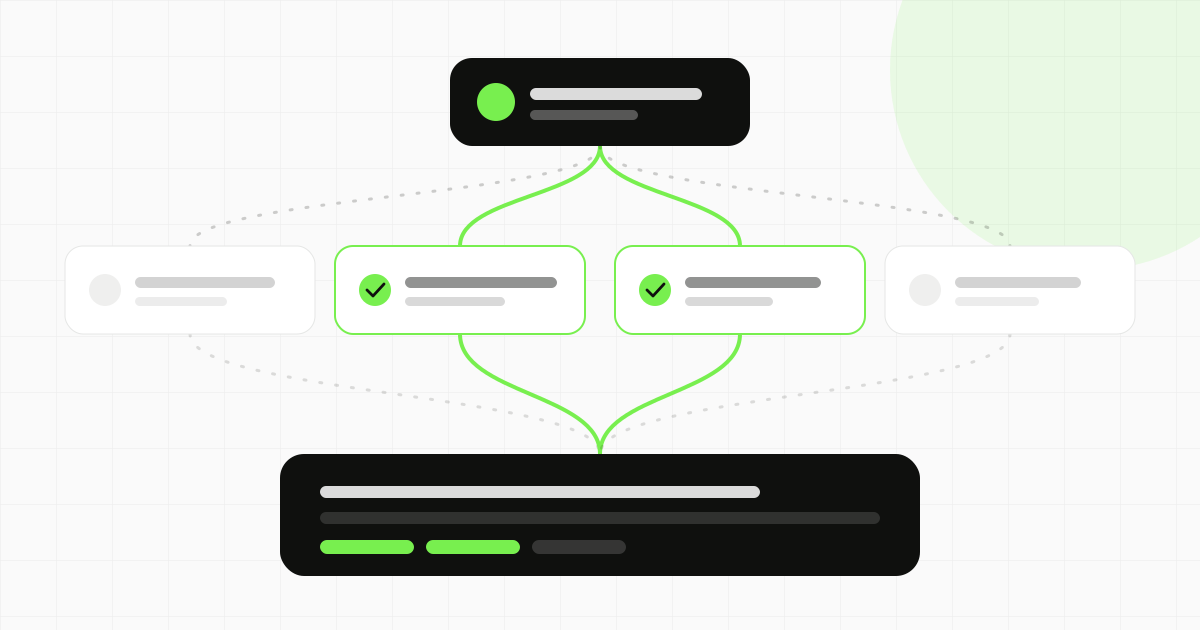
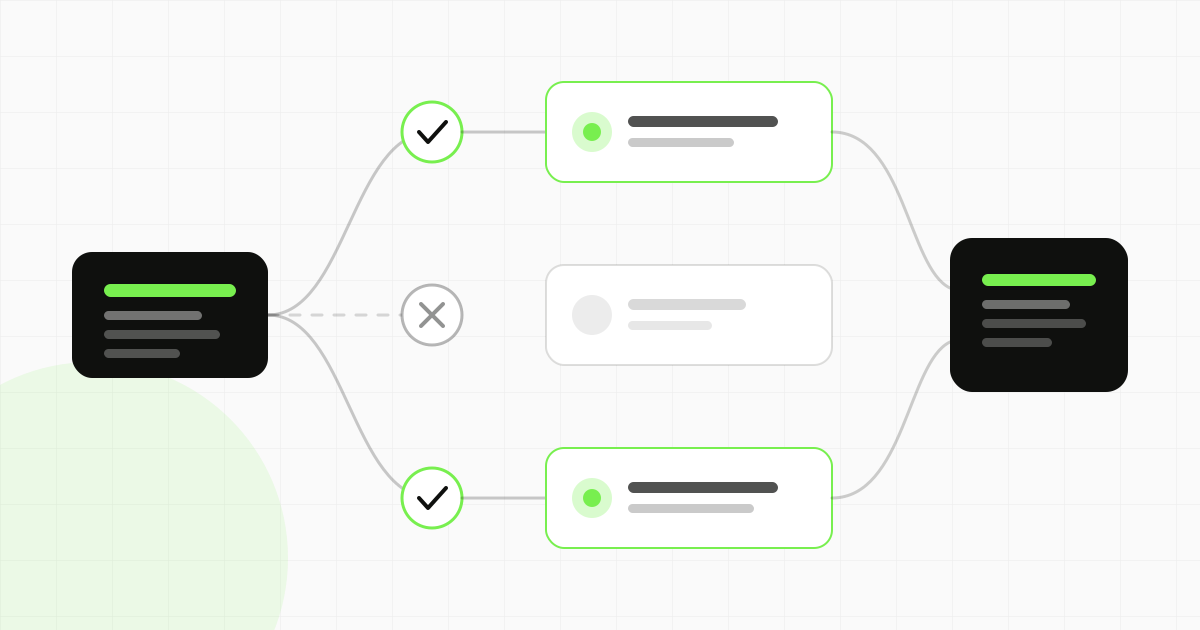
The reason lies in how the systems work: they break a question into sub-questions and search for each one separately. Whatever ranks for the original query is therefore only one source among several.
The Gartner Forecast Has Expired
Nearly every text on the subject carries a figure from Gartner: search volume down 25 per cent by 2026, organic traffic down 50 per cent by 2028. The press release is dated 19 February 2024.
The first deadline has now passed. The drop by a quarter did not happen. Google still holds over 90 per cent market share in search, as of April 2026. The reason was foreseeable: Google pulled the answering function into its own search with the AI Overviews rather than ceding volume to chatbots.
Passing the forecast on today as a statement about the future means quoting a prediction whose deadline has come and gone. The shift that did take place is a different one, and less comfortable in practice: the queries stayed. The clicks did not.
How a Generative System Arrives at Its Answer
Without this intermediate step every measure stays an assertion. An answer comes from two sources.
The first is training. What a model learned about a topic or a brand comes from text that was available at the time of training. That layer cannot be edited, it is old, and for smaller brands it is thin to empty.
The second is retrieval at runtime, technically retrieval augmented generation. On a question the system looks for matching documents, reads them and formulates the answer from them. This is where GEO applies: that layer can be influenced, because it consists of retrievable pages.
Query Fan-Out: One Question Becomes Several Searches
The systems do not issue one search query but several. "Which agency fits for B2B link building?" turns into sub-questions about selection criteria, prices, providers and risks. Each sub-question gets its own search.
In practice that means two things. A page can be cited without ranking for the original question at all, because it answers one of the sub-questions cleanly. Conversely a page at position 1 can go uncited if it offers no self-contained statement on any sub-question.
That explains the drop from 76 to 38 per cent. And it shifts the work: away from the one perfect page for a keyword, towards solid statements on many concrete questions.
GEO applies at steps three and four: being retrievable and being evidenced. Nobody has access to how the answer itself gets worded.
GEO and SEO: What Stays, What Is Added
GEO does not replace SEO, it builds on it. A page that is not indexed does not get retrieved either.
Area
For rankings
For citation in AI answers
Indexability, load time, structure
precondition
precondition
Keywords and search intent
central
secondary, questions count for more than terms
Backlinks
central
indirect, via authority and discoverability
Mentions without a link
minor
high, as an independent naming of the brand
Citable individual statements
secondary
central
Structured data
supporting
supporting, for assigning entities
Currency with a date
depends on the topic
relevant throughout
The row that makes the difference is the fifth. For a ranking the page counts as a whole. For a citation what counts is the single sentence that can be lifted out and reproduced without context.
GEO and AEO: Why the Terms Belong Apart
Answer Engine Optimization, AEO for short, is often used synonymously. The terms overlap, but they do not mean the same thing.
AEO is the older and narrower term. It comes from the era of featured snippets and voice assistants: optimizing for the one direct answer to a concrete question.
GEO is broader. It concerns generative systems that assemble an answer from several sources, take context into account and follow up in dialogue.
The blurring is not a quarrel about words. Whoever does AEO optimizes individual question-answer pairs. Whoever does GEO additionally has to make the brand recognisable as an entity and get independent sources to say the same thing. That is considerably more work, and it falls in a different place.
GEO sells itself as the future and is largely the know-how of yesterday. That is good news, because plenty of teams already have it.
David Hahn, Managing Director, GetMentioned
The GEO Levers, Ordered by Evidence
Plenty of recommendations circulate about GEO and few of them come with evidence. The following order separates the two.
Evidenced: What the Study Measured
The paper by Aggarwal and colleagues tested nine interventions on texts, against a benchmark of 10,000 search queries. The most effective ones raise visibility in generated answers by up to 40 per cent:
Cite sources. Statements with a reference to where they come from get picked up more often than those without.
Include figures. Concrete values instead of general descriptions raise the probability of being taken up considerably.
Use quotations. Verbatim statements from nameable people or institutions work in a similar way.
Write clearly. Readable, well-formed versions are preferred over convoluted ones.
What is remarkable about the list is what is missing: keyword density, text length, heading structure. The interventions that work concern how well a statement is evidenced, not how it is optimized for a search term.
One point of context: this is a laboratory finding on a benchmark, not a guarantee for your own market. The study itself notes that the effect varies by subject area.
Plausible: What Follows From How the Systems Work
These levers are not measured in a study, but they follow directly from how the systems operate:
Spell entities out. Company names, product names, people with their role, places with the country, instead of "we" and "our offering". "We offer placements" becomes "GetMentioned arranges placements with publishers". A model links named things, not pronouns.
One statement per paragraph. What is meant to be quoted has to survive being lifted out.
Answer sub-questions directly. The question as the heading, the answer in the first sentence below it, the reasoning after that.
Tables for comparisons. Structured entries get reproduced correctly more reliably than running text with subordinate clauses.
Make the date visible. Without a status, every entry is timeless, including the superseded one.
Add structured data. Schema.org helps with assignment but does not replace the readable text.
The Lever Outside Your Own Website
Your own page is one source among many. Generative systems weight matching statements from independent sources higher than a provider's account of itself. When trade media, directories and guides say something different from your own page, your own page rarely prevails.
That is why part of GEO happens off your own domain: mentions in third-party publications, appearances in comparisons and overviews, evidence a system can lean on. How to build that is covered in AI Mentions. The fact page as its counterpart is covered in Grounding Page.
This external evidence is exactly what you build predictably with GetMentioned: pick fitting publishers, compare SEO data and prices, book placements directly and document publications centrally.
What GEO Does Not Do
GEO Does Not Force a Citation
There is no mechanism obliging a system to draw on a particular page. Every lever raises probabilities. Anyone promising guarantees is selling something else.
GEO Does Not Replace Rankings
Even with only about four in ten citations coming from the top 10: those four are real, and discoverability through classic search remains the route by which a page enters the retrievable pool at all.
GEO Gives No Control Over the Answer
A system formulates for itself. It can quote correctly and still place the quote in a context you would not have chosen. What is steerable is the source situation, not the result.
GEO Does Not Work Immediately
Weeks pass between publication and effect. A page has to be indexed, retrieved and weighted against other sources. Anyone seeing no effect after two weeks has not done too little; they have looked too early.
How to Measure GEO Success
Getting started costs ten minutes: ask the systems that matter to you the questions a prospect would ask. Note whether your brand gets named, in what context, alongside which competitors, and which sources carry the answer.
That spot check becomes a measurement once it is repeatable: a fixed set of questions, a fixed interval, the same systems, documented results. How to set that up systematically, with metrics such as Share of Voice and Share of Model, is covered in AI Visibility.
Conclusion: GEO is evidence work
Generative Engine Optimization is not a new discipline with tricks of its own but the extension of an old question under new conditions: why should a system draw on you in particular?
The evidenced answers to that are unspectacular. Statements that stand on their own. Figures with a source. Clear language. Names spelled out. And, off your own website, independent sources saying the same thing. That is less exciting than the forecasts the subject is usually sold with, and it lasts longer.
Frequently asked questions about GEO
What is Generative Engine Optimization?
The work of getting content to appear in the answers of generative systems such as ChatGPT, Perplexity, Gemini or the AI Overviews. The goal is being named in an answer, not a position in a list of results.
What is the difference between GEO and SEO?
SEO targets rankings and clicks, GEO targets citation in a generated answer. GEO builds on SEO. What is not indexed does not get retrieved. The difference lies in the unit at stake, for SEO the page, for GEO the single citable statement.
What is the difference between GEO and AEO?
AEO is older and narrower and comes from the era of featured snippets: optimizing for a direct answer. GEO covers generative systems that assemble an answer from several sources, and it includes the work on entities and external evidence.
Does GEO work measurably?
The study by Aggarwal and colleagues (ACM SIGKDD 2024) measures a visibility increase of up to 40 per cent on a benchmark of 10,000 queries, through interventions such as source citations, figures and quotations. For your own market that is an indication, not a commitment.
Is SEO dead because of AI search?
No. In February 2024 Gartner forecast a 25 per cent drop in search volume by 2026; it did not happen, and Google still holds over 90 per cent market share. What changed is not the volume but the click-through rate.
How much do AI Overviews hurt clicks?
Using data from December 2025, Ahrefs measured a 58 per cent lower click-through rate for position 1 on keywords with an AI Overview. Eight months earlier the same figure stood at 34.5 per cent.
Is a good ranking enough to get cited?
Less and less. In July 2025 around 76 per cent of the URLs cited in AI Overviews came from the top 10 of the same search; by March 2026 only about 38 per cent did. The systems break a question into sub-questions and search for each separately.
What is query fan-out?
The breaking of a question into several sub-questions that are searched for separately. That is why a page can be cited without ranking for the original query, and the other way round.
Do I need structured data for GEO?
It helps with assigning entities and never hurts. It does not replace the readable text, though: what gets cited is what a model can read as a statement.
How long does GEO take to work?
Weeks, not days. A page has to be indexed, retrieved and weighted against other sources. Checking intervals of a few weeks make more sense than daily inspection.
Can I force a citation?
No. There is no markup and no format that obliges a system to use a particular source. What is steerable is the probability, not the result.
David has been building link acquisition and digital PR processes since 2016, first as an agency under SEO Galaxy, today as a platform with GetMentioned. He has scaled his own projects from zero to seven-figure monthly traffic and delivered thousands of campaigns for clients. Here he writes about what works in practice, and about what only costs budget.
Your next link does not have to be a blind buy
Compare publishers, SEO data and prices in one place and book the placements that fit.
Every AI system runs its own crawlers, and each has a different job. Why the widely repeated advice about Google-Extended does not work, and what Google and Microsoft actually ask for.
AEO works on the individual section, not the whole page. What Google says about the term, which levers hold up and how to build a section an answer engine can use.
Reddit is treated as the most cited source in AI answers, and the studies on it disagree by a factor of ten. Which domains actually appear, why forums rank so high, and which of those sources can be influenced at all.