Digital PR is the work of getting independent media to report on a brand, quote it or link to it. The basis is a reason a newsroom actually wants to use: original data, an expert take, a story. The backlink follows from the publication.
The difference from classic press work lies in the goal. Classic PR measures media value and reach. Digital PR also measures what a publication does for discoverability and authority, in search engines and in AI answers.
What digital PR is
Digital PR places stories, data and expertise where an audience researches and compares. That means trade media, industry portals, newsletters, podcasts and communities.
Three questions come first:
Which media shape perception in this market?
What reason can we supply that a newsroom wants to use?
Which target page should benefit from the publication?
Earned, owned and paid
The three kinds of media differ in how much control you hold, and that degree of control determines their credibility.
Kind
Control
Example
Effect on authority
Owned
full
your website, newsletter, study
supplies the substance
Paid
high
advertorial, sponsorship
plans reach and timing
Earned
none
editorial mention, quote
carries furthest
Earned media weighs most because the brand does not control the statement. That is exactly what makes it credible to readers and to search systems.
Owned media is the precondition. Without your own study, your own data or your own position, there is nothing to report on.
How digital PR relates to link building
Classic link building starts from the question of where a link should appear. Digital PR starts from the question of what a newsroom wants to publish. In the second case the link is a by-product of the placement.
Both routes have their place and they do not exclude each other. Which discipline fits when is covered in the article comparing digital PR and link building.
Where a reason comes from
Newsrooms do not publish self-description. They need something their readers care about.
Your own data
The most reliable reason. Analysing figures from your own business delivers something nobody else has. An analysis of prices, durations, failure rates or market movements gets quoted because it is quotable.
Methodology decides whether it can be used. No serious newsroom takes a figure without a collection period and a sample size.
A usable dataset does not have to be large. An analysis of a few hundred of your own cases is enough as long as period, population and procedure are disclosed. Offering the raw data for download noticeably raises the chance of being picked up.
A take on a running story
When a topic is live, newsrooms look for experts to put it in context. That only works at speed. A take that arrives three days after the news finds no space.
Experience from practice
What stands out in daily work is often new to outsiders. Typical mistakes, recurring patterns, cases with an unusual course. In our experience this is the most underrated reason, because it needs no budget.
What is not a reason
a new version of your software with no effect on anyone else
a personnel change below board level
a round-numbered company anniversary
an award you applied for yourself
The formats
Journalist outreach
Approaching newsrooms that actually write about the topic. What goes out are individual messages with a clear hook, not a circular to a distribution list.
A usable pitch answers three questions in the opening lines. Why does this matter now? What does the reader get? What exactly are we supplying, meaning data, a quote or images?
The press kit
A page on your own site with everything a newsroom needs. Company profile, figures and facts, print-resolution images, short biographies of your experts, a contact address.
The benefit is easy to state. The less anyone has to ask for, the more likely the publication happens.
Guest articles
An expert piece in someone else's outlet. It works when it delivers real expertise and fits the topic.
Generic texts in arbitrary portals do not serve the purpose. A good guest article answers a concrete question for that readership and links to a substantial resource rather than to the homepage.
Advertorials and paid placements
Paid pieces are a tool, not a taboo. They make sense when a specific outlet needs to be reached or when the timing is fixed.
Newsrooms do not turn down press releases because they are badly written. They turn them down because there is no story in them that their readers care about.
David Hahn, Managing Director, GetMentioned
Three conditions apply. The labelling has to be correct, the piece has to fit editorially, and it has to be worth something to the reader. An advertorial that reads like an ad costs trust instead of building it.
Interviews, podcasts and partnerships
Experts with a view get invited. In B2B this runs through industry podcasts, newsletters, conferences and posts on professional networks.
The value lies in repetition. Appearing regularly in your topic area gets you perceived as part of that area, by people and by search systems.
Regional and multilingual placements
Authority does not carry over automatically from one market to the next. Being established in Germany does not make you established in Austria or Switzerland.
Every target market needs its own media, its own contacts and usually its own language. That is laborious and hard to shortcut.
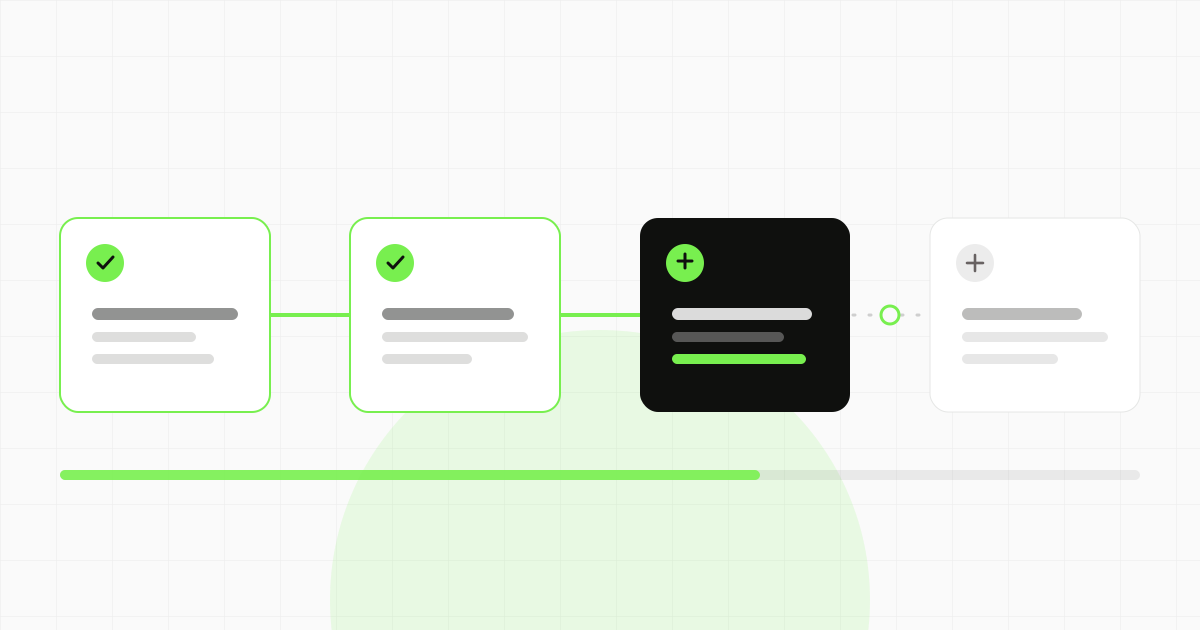
How a campaign runs
Fix the reason. Data, a take or experience, with a clear statement in one sentence.
Build the material. Analysis, charts, quotes, images, a target page.
Build the media list. Twenty to fifty newsrooms that genuinely cover this topic.
Reach out. Individually, personalised, with the hook in the subject line.
Follow up. Once, after a few days.
Document. Who published, with or without a link, in what context.
How a campaign runs, in five steps.
The second step takes the most work. Cutting corners there cuts the result.
For the media list, fit beats size. A newsroom that has already covered the topic three times is worth more than ten that never have. This groundwork costs time and saves several rounds of follow-up later.
Follow-up stays at one attempt. Chasing repeatedly gets you marked as a sender and loses you the next story.
What digital PR achieves, and when
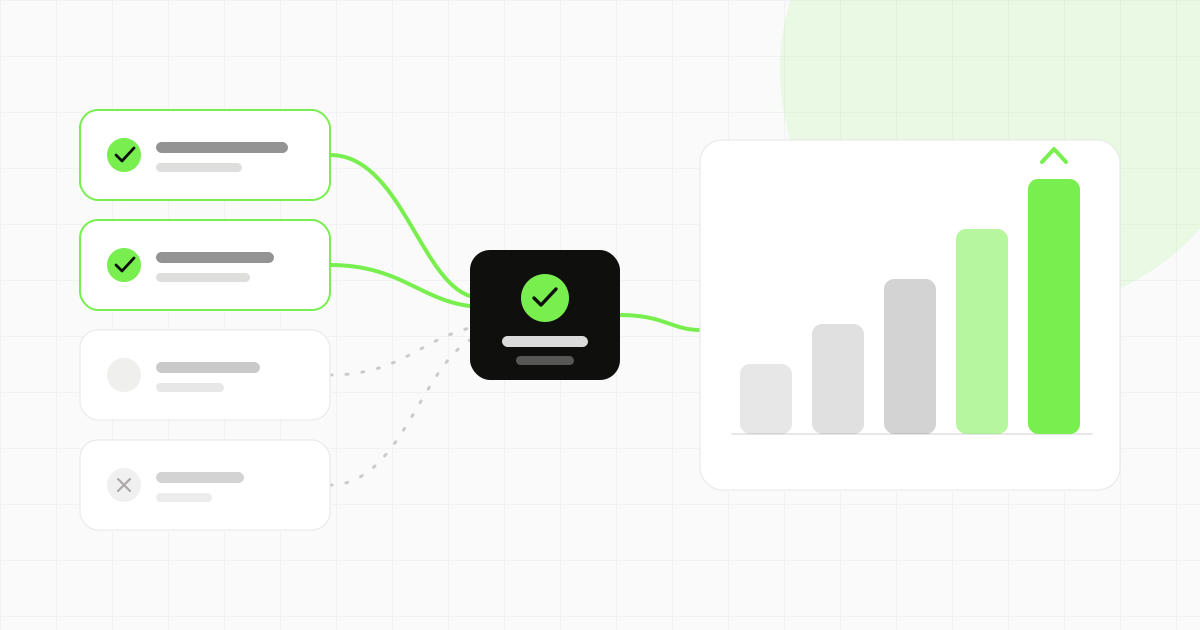
Three levels can be observed:
Publications. Number and quality of placements, mentions with and without a link.
Search engines. New referring domains, visibility of target pages, branded searches, referral traffic.
Perception. In what context the brand is named and whether it appears regularly in its own topic area.
How this becomes a steerable programme with goals and metrics is covered in the article on digital PR strategy.
On the timeline
In our experience first effects appear after four to eight weeks, once the first placements go live. That means referral traffic and individual strong links.
Stable shifts in organic visibility usually take three to six months. In competitive markets, authority is a lever over six to eighteen months.
These ranges are experience from projects rather than measured averages. They depend heavily on how often you publish and how well the target pages were set up beforehand.
Which tools serve which job
No single tool covers the whole process. Sorting by job is more useful than sorting by vendor.
Job
What for
Examples
Monitoring
finding mentions, including unlinked ones
media monitoring services
Contact data
finding newsrooms and who covers what
PR databases
Source requests
responding to journalist queries
query platforms
Measurement
links, visibility, referral traffic
SEO tools
Placement
finding and booking suitable publishers
GetMentioned
For placement itself, GetMentioned lets you compare publishers by topical relevance, SEO data and price, and book publications directly. It does not replace a relationship with a newsroom. It closes the gap when a placement is needed at a particular time in a particular environment.
Common mistakes
The reason is missing and the distribution list is supposed to fix it.
The pitch describes the company instead of the story.
The media list is too large and too unspecific.
The target page behind the link does not deliver what the article promised.
Mentions without a link go unrecorded even though they count.
Nothing follows the first campaign.
Conclusion: the reason decides
Digital PR starts from the question of what a newsroom wants to publish. Everything after that, meaning media list, pitch, press kit and follow-up, is craft that does not carry without that reason.
Anyone with something to say regularly gets named regularly. Out of that repetition comes the authority that search engines and AI systems assign to a source.
Frequently asked questions
What is digital PR?
The work of getting independent media to report on a brand, quote it or link to it. The basis is a reason a newsroom wants to use, such as original data or an expert take.
How does it differ from classic PR?
Classic PR measures media value and reach. Digital PR also measures the effect on discoverability and authority, meaning referring domains, visibility of target pages and mentions in AI answers.
Is digital PR the same as link building?
No. Link building starts from where a link should appear. Digital PR starts from what a newsroom wants to publish, and the link follows from that.
Do I need an agency?
No. Starting in-house works if there is time for research and outreach. Consistent frequency across several markets is where support pays off.
How long until digital PR works?
First effects typically show after four to eight weeks, stable shifts in visibility after three to six months. Competitive markets take longer.
Do mentions without a link count?
Yes. An unlinked mention anchors the brand in its topic area and is read by AI systems much like a link. It should be recorded alongside linked ones.
How many outlets belong on a list?
Twenty to fifty newsrooms that genuinely cover the topic. Large distribution lists lower the response rate because the approach becomes unspecific.
Are paid placements acceptable?
Yes, when labelled, editorially appropriate and worth something to the reader. What causes problems are placements that exist purely to manipulate rankings.
What belongs in a press kit?
Company profile, verifiable figures, print-resolution images, short biographies of your experts and a contact address. The less anyone has to ask for, the more likely the publication.
Does a press release still work?
As a mass mailing, rarely. With real news and sent to the right newsrooms, it still works.
How do I measure success?
Across three levels: the number and quality of publications, the effect in search engines through referring domains and visibility, and perception, meaning the context in which the brand is named.
David has been building link acquisition and digital PR processes since 2016, first as an agency under SEO Galaxy, today as a platform with GetMentioned. He has scaled his own projects from zero to seven-figure monthly traffic and delivered thousands of campaigns for clients. Here he writes about what works in practice, and about what only costs budget.
Your next link does not have to be a blind buy
Compare publishers, SEO data and prices in one place and book the placements that fit.
Both build external authority, but along different routes, costs and time horizons. A decision aid along your own starting position, with the data that actually exists on it.
Strong content, flat rankings: usually what is missing is not the next idea but a process. Four phases from goals through linkable assets to KPIs, with the to-dos for each step.
How search engines and AI systems weigh links, which methods exist, what link building costs and how paid placements should be judged. The overview, with pointers into the detail.