Visibility index: what it measures and what it stopped showing in 2025
The visibility index sums up a domain's Google rankings, weighted by search volume and click probability. What the number says, why it is a zero-sum game and what it stopped showing once AI Overviews arrived.
The visibility index sums up all of a domain's Google rankings, weighted by search volume and expected click probability. Sistrix has tracked it since 2008.
It is a zero-sum game. A fixed pool of 100,000 points is shared across every domain in a country, so you can lose ground without ranking worse yourself.
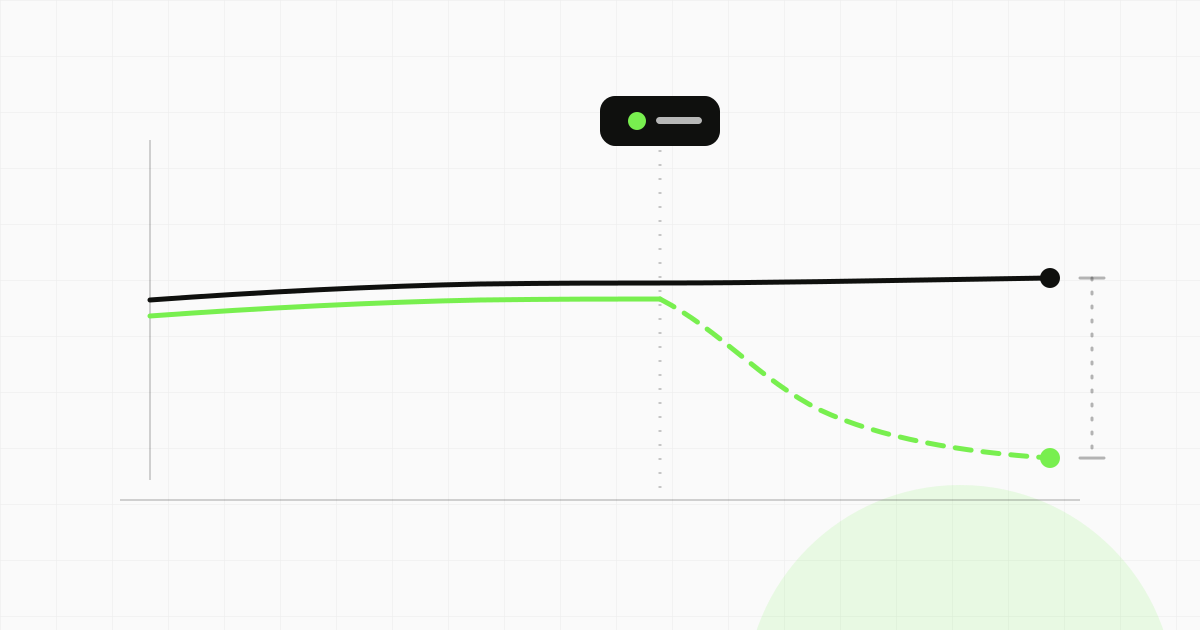
Sistrix states itself that AI Overviews do not feed into the index. At the same time Sistrix measures the click rate on position 1 falling from 27 to 11 percent when an AI Overview appears.
A randomised experiment in 2026 provides the first causal evidence that AI Overviews cut organic clicks by close to 40 percent.
The index remains useful for comparing yourself against competitors. As a gauge of whether visitors actually arrive, it has weakened.
Kostenfrei starten
Check links instead of guessing
100,000+ publishers with traffic, history and price per domain, all openly visible.
The visibility index is a metric for how visible a domain is in Google's search results. Sistrix has tracked it since 25 February 2008, measuring thirteen countries daily and the rest weekly.
The number answers one question. How many people could theoretically see this domain on Google? It explicitly does not answer how many actually arrive. More on that below, because that is exactly where the problem sits in 2026.
How it is calculated
The calculation runs in three steps, and Sistrix documents them openly.
Collection. Search results are pulled for around one million queries per country, up to a hundred positions each. That yields roughly 100 million data points. The keyword set is meant to reflect a cross-section of national search volume and gets refreshed regularly. (Source: Sistrix, 2026)
Weighting. Each ranking is weighted by two things, the keyword's search volume and the expected click probability at the measured position. A first place on a heavily searched term counts for a lot, a ninetieth place on a rare one for almost nothing.
Aggregation. All weighted rankings for a domain are added up. The sum is the index value.
Ads and special result formats do not count. The index knows organic results only.
What the number says and what it does not
This is where most of the misreadings happen. Four properties are worth knowing.
It is a zero-sum game
A fixed pool of 100,000 visibility points is distributed across every ranking domain in a country, and the pool is the same size in every country. (Source: Sistrix, 2026)
One consequence surprises many people. Your domain can lose points even though none of your rankings changed. It is enough for other domains to improve. A falling index is therefore no proof that you did something wrong.
It is not a traffic index
Sistrix says so plainly. The visibility index is not designed as a traffic index; it measures SEO performance rather than visitor numbers. In most cases the two move together, but they do not have to.
Part of the reason sits in the construction. Sistrix works with an annual average of search volume that stays constant across all months, so that ranking changes show up in isolation. That makes the index blind to seasonality. On a seasonal topic it can climb while visitors stay away, and the reverse.
Absolute values say little on their own
Sistrix deliberately names no target values and recommends comparing against your own competitors instead. In its own words, a zero before the decimal point does not mean a website is unsuccessful.
The reason lies in the keyword set. It reflects the average of an entire country, so a broad department store inevitably scores higher than a specialist with ten products. Comparing across such boundaries misleads. Across countries the value is comparable, an index of 10 in Germany equals an index of 10 in the United States.
It measures visibility, not quality
The index says nothing about the strength of your link profile. Separate metrics exist for that, such as Trust Flow. The two get confused regularly but measure different things, one presence in the search result, the other the trustworthiness of the referring domains.
Where to look it up
The visibility index in the narrow sense exists only at Sistrix; the term is their metric. Other providers have their own measures serving a similar purpose but calculating differently. For an overview of the tools and what they are good for, see our roundup of link building tools.
One thing matters when looking it up. A single value without comparison is worth little. Always pull two to five direct competitors alongside it and read the trend rather than the daily figure.
The alternatives compared
Tool
What is measured
Keyword set
Key difference
Sistrix visibility index
sum of weighted top 100 rankings
fixed, around 1 million per country
market-wide comparison value
Semrush Visibility
visibility in the top 100 on a CTR basis
self-selected
not comparable between two accounts, because everyone curates a different list
Ahrefs Share of Voice
share of your clicks against all clicks in the result
self-selected
a share measure, one hundred percent is structurally unreachable
Ahrefs Domain Rating
strength of the link profile
none
measures no visibility at all, yet gets confused with it most often
Google Search Console
real clicks, impressions, click rate, position
none, your own site only
measured rather than modelled, but no view of competitors
Search Console is the only source with real data. It carries one catch that became important in 2026. Google counts an appearance in an AI Overview as a single position, and every link inside it receives that same position. Your average position can improve while the clicks disappear.
What the index no longer shows in AI search
This is the part that puts the metric in question in 2026. Two statements from the same provider sit side by side.
Sistrix wrote in May 2025 that AI Overviews do not displace organic results and are therefore not counted in the visibility index. That statement still stands unchallenged in the documentation, and the underlying calculation has not changed since 2008. (Source: Sistrix, 2025)
In February 2026 Sistrix published an analysis of more than 100 million keywords in the German index. The findings:
The click rate on position 1 falls from 27 to 11 percent when an AI Overview appears. (Source: Sistrix, 2026)
Across all keywords that costs Germany around 265 million organic clicks per month, an average of minus 6.6 percent. (Source: Sistrix, 2026)
The spread is enormous. Some portals lose around one percent, health sites up to more than 30 percent. (Source: Sistrix, 2026)
Put together, the two statements describe the gap. The position stays the same, the search volume stays the same, so the index value stays the same. The click, however, is gone. The very quantity the index models through its click weighting has changed without the index changing.
How solid is the evidence?
For a long time only correlations existed, and those carry a known weakness. Queries showing an AI Overview skew informational, and informational queries always produced fewer clicks. Semrush pointed exactly at that and found in its own analysis a slight decline in the zero-click rate, from 33.75 to 31.53 percent. (Source: Semrush, 2025)
Since June 2026 there is a clean answer. A randomised field experiment with 1,065 participants, in which AI Overviews were stripped out live via a browser extension, finds organic clicks dropping by 39.8 percent, from 0.62 to 0.37 clicks per search. The study is preregistered and not yet peer reviewed. (Source: Agarwal and Sen, 2026)
Two side findings are telling. Clicks on ads stayed unchanged, so the shift hits organic results alone. And Google's argument that AI answers deliver better clicks in return did not hold up. Time on page, bounce rate and return rate showed no difference.
Ahrefs measures a 58 percent drop in click rate at unchanged position, across 300,000 keywords using Search Console data. The same provider had measured 34.5 percent in 2025 and revised the figure upward itself. (Source: Ahrefs, 2026)
None of this is an obituary for the metric. For competitive comparison it still works, because every domain in a market is affected alike. As an answer to whether visitors arrive, it has weakened. And it says nothing about whether your brand appears in AI answers at all. What counts there is covered in our piece on visibility in AI systems.
How to measure visibility today
One consequence follows from all this. A single number no longer suffices, it takes two side by side.
The first is classic visibility in the search result, where the visibility index remains the established yardstick for comparison. The second is visibility in AI answers, meaning whether your brand gets named when someone asks a language model about your topic.
MentionIQ covers both. It analyses your website and your competitors, shows your backlink gaps and your visibility gaps against the competition, both in classic SEO visibility and in visibility inside large language models and AI search. On that basis it recommends suitable placements. How to track the development continuously is shown by our monitoring.
The visibility index still measures reliably what it always measured. It just no longer measures what most people ask it.
David Hahn, Managing Director at GetMentioned
How to read the number from now on
Three things. The visibility index remains the best available yardstick for comparing yourself with competitors. It is not a traffic measure and was never meant as one, which matters more in AI search than it used to. And it does not answer whether your brand appears in AI answers.
Frequently asked questions
What is the visibility index?
A metric for how visible a domain is in Google's search results. It sums up all of a domain's rankings, weighted by search volume and the expected click probability at each position. Sistrix has tracked it since 2008.
What counts as a good visibility index?
There is no universal target value, and Sistrix deliberately names none. Only the comparison with direct competitors and the trend over time carry meaning. A low value does not mean a website is failing.
How is the visibility index calculated?
Search results are collected for around one million keywords per country. Each ranking is weighted by search volume and expected click probability, then all values for a domain are summed.
Why is my visibility index falling when my rankings are unchanged?
Because a fixed pool of 100,000 points is shared across all domains in a country. If other domains improve, you lose share without having got worse. A refreshed keyword set can move the value too.
Is the visibility index the same as traffic?
No. Sistrix states plainly that the metric is not a traffic index. The two often move together but diverge, for instance on seasonal topics, because the index works with an annual average of search volume.
Does the visibility index account for AI Overviews?
No. Sistrix recorded in 2025 that AI Overviews do not displace organic results and therefore do not feed into the index. Since the click rate demonstrably falls when an AI Overview appears, the index does not reflect that loss.
What alternatives to the visibility index exist?
Semrush and Ahrefs offer their own visibility measures, though these rest on self-selected keyword lists and are therefore not comparable market-wide. Only Google Search Console delivers real data, but without any view of competitors.
David has been building link acquisition and digital PR processes since 2016, first as an agency under SEO Galaxy, today as a platform with GetMentioned. He has scaled his own projects from zero to seven-figure monthly traffic and delivered thousands of campaigns for clients. Here he writes about what works in practice, and about what only costs budget.
Your next link does not have to be a blind buy
Compare publishers, SEO data and prices in one place and book the placements that fit.
AI answers recommend providers before anyone clicks a ranking. How to measure AI visibility, which signals carry it, and where the external evidence models lean on comes from.
Trust Flow looks like a decision number, and that is exactly the problem. How the Majestic metric is built, what counts as a good value, and which decisions you can actually take from it.
Share of Model tracks a brand's share of all brand mentions in AI answers. Why the formula is uncontested but the denominator is not, and why two vendors can report different values for the same brand on the same day.