
Strategy
Grounding Page: The Fact Sheet AI Systems Quote From
A grounding page bundles the verifiable facts about a company for AI systems. What belongs on it, how to build it and why it does not carry on its own.
August 14, 2026 · 14 min read
SEO Galaxy is now GetMentioned. The platform stays the same. Want a demo? Book your slot here →
A draft specification describes how AI agents find callable resources on the web without going through a search engine. It stands at version 0.9 with the status Proposal, ratified by no standards body. What it covers today and what is still open.

David Hahn · August 26, 2026 · 6 min read
The short version
/.well-known/ai-catalog.json.Agentic Resource Discovery, ARD for short, is a specification for how AI agents find resources on the web. The resources are tools, APIs, MCP servers and skills that an agent can call. Eleven organisations published the draft on 17 June 2026. The specification itself carries the earlier date 28 May 2026.
This post places the current state for SEO and marketing leads.
Agentic Resource Discovery describes a discovery layer for agentic resources. A client agent gets a task and looks for a matching capability.
Today this runs through fixed integrations. An agent knows only the tools entered in advance. The specification calls this the discovery problem.
ARD replaces the fixed list with a search in natural language. Hugging Face describes ARD as the discovery layer in front of MCP, Skills and A2A.
The ARD specification lists version v0.9 with the date 28 May 2026. The status there is set to Proposal, the licence to Apache License 2.0.
A proposal is a suggestion. No standards body has ratified the text.
One sentence about ARD circulates widely. "ARD is the new standard for AI search." A more accurate version reads "ARD is a draft at v0.9 that eleven organisations put forward."
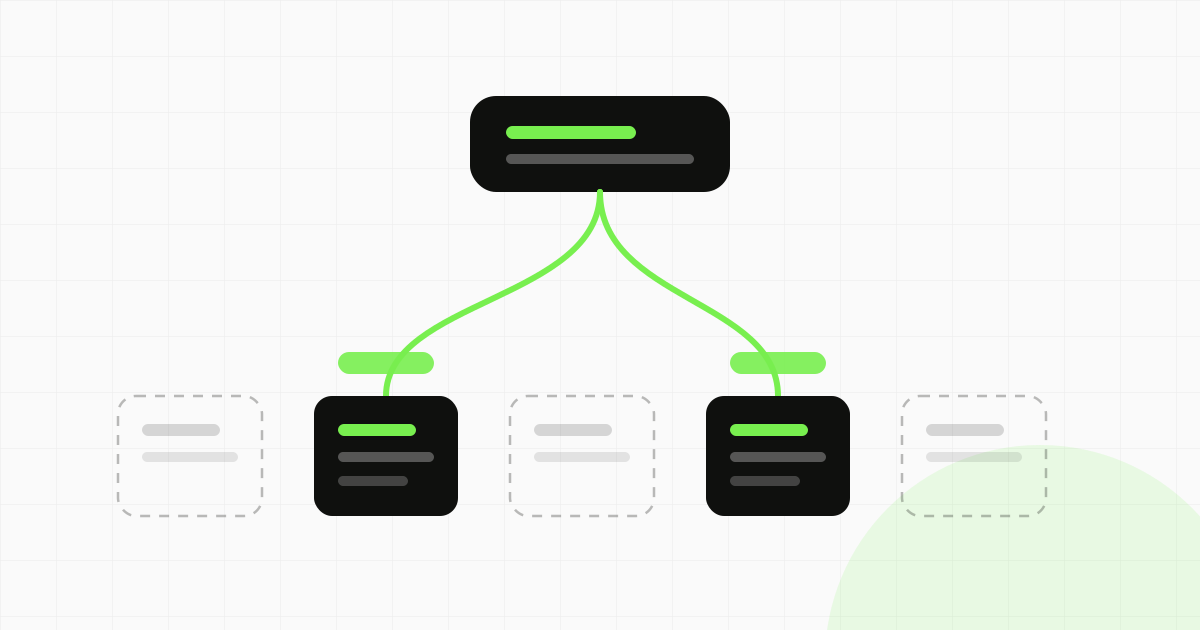
The catalog is a JSON file at https://<domain>/.well-known/ai-catalog.json.
| Component | What it contains |
|---|---|
| Manifest | format version and the list of entries |
| Host | the organization the entries belong to |
| Catalog entry | identifier, name, type, URL and description |
The domain carries the trust question. Anyone serving the catalog from their own address proves the entries belong to them.
MCP governs how an agent calls a tool. ARD governs how it finds that tool first.
The specification treats MCP as one artefact type among several. An entry for an MCP server carries the media type application/mcp-server-card+json.
Microsoft, Google, GitHub, Hugging Face, GoDaddy, Cisco, Databricks, Nvidia, Salesforce, ServiceNow and Snowflake are involved. Hugging Face calls it a "draft, open specification developed by contributors ... and others".
Two names are missing. OpenAI and Anthropic are not on that list.
Hugging Face released its Discover tool the same day. In the provider's words it offers "search access to thousands of Skills, ML applications, and MCP Servers ... across other ARD discovery services".
The catalog sits at https://huggingface.co/.well-known/ai-catalog.json.
Drupal founder Dries Buytaert published an ai-catalog.json on his website in July 2026. It was meant to make his site search discoverable for agents.
The Hugging Face registry answered correctly by the protocol. In his test it returned only skills hosted at Hugging Face itself.
He sums it up in one sentence. "If an agent has never heard of you, it does not know to look for your API catalog."
Catalogs can be published today. The number of registries in the ecosystem stays small. Support from the large assistant systems is outstanding.
My advice on ARD today is to read the specification and keep watching. I would plan budget once a second registry answers.
Discoverability has two surfaces for brands. One is search engines, the other is language models and answer engines.
ARD describes a third surface. It addresses software that carries out a task.
A catalog lists callable functions and no marketing claims. A provider with a public API can create an entry today. A brand without an API cannot.
The familiar routes still carry visibility in search and language models. Measuring it is covered in LLM Visibility, work on the surfaces themselves in AI Search Optimization.
GetMentioned is an SEO platform with its own placement marketplace: analysis, content and placements for backlinks, brand mentions and digital PR in one system. Full service in link building, not full-service SEO. We make sure a brand is evidenced outside its own domain.
A grounding page collects verifiable facts about a company for systems that generate answers. At GetMentioned it sits at Facts about GetMentioned.
An ARD catalog lists callable resources for agents that carry out a task. How a system names a brand at all is covered in AI Mentions.
So far the topic concerns providers with callable functions. Four cases are recognisable:
In our experience, young specifications are worth checking against the platform in use. If a CMS supports ARD, the catalog appears without your own work.
Agentic Resource Discovery answers a question that comes before MCP. An agent has to find a resource before it calls it.
The state today is a draft with eleven organisations and few registries. Anyone publishing a catalog now serves an audience that is just forming.
A specification for how AI agents find callable resources on the web. Providers publish a catalog, registries index it.
No. The specification carries version v0.9 and the status Proposal, dated 28 May 2026.
On your own domain at /.well-known/ai-catalog.json. Domain ownership serves as the trust anchor.
MCP describes how an agent calls a tool. ARD describes the search that comes before.
Eleven organisations, among them Microsoft, Google, GitHub, Hugging Face, GoDaddy, Databricks and Snowflake. OpenAI and Anthropic are not among them.
No. ARD addresses agents that call a function. For people and language models, search engines remain the surface.
It makes sense for domains with callable functions such as an API, a search or a booking.

About the author
Managing Director, GetMentioned
David has been building link acquisition and digital PR processes since 2016, first as an agency under SEO Galaxy, today as a platform with GetMentioned. He has scaled his own projects from zero to seven-figure monthly traffic and delivered thousands of campaigns for clients. Here he writes about what works in practice, and about what only costs budget.
Compare publishers, SEO data and prices in one place and book the placements that fit.
A grounding page bundles the verifiable facts about a company for AI systems. What belongs on it, how to build it and why it does not carry on its own.
August 14, 2026 · 14 min read
Whether a brand appears in answers from ChatGPT, Perplexity or Gemini can be measured. How AI Mentions come about, which KPIs matter and what repeatable monitoring looks like.
August 14, 2026 · 12 min read
A brand surfaces either from model weights or from a web search at runtime. A half-hour test separates the two, and that decides whether the work takes days or months.
August 16, 2026 · 12 min read