You pay for publication, but what counts is the page being in the index. How to sample a publisher's indexing reliability before booking, how long inclusion takes, and what to do when a placement never makes it in.
Backlink indexing describes the moment a search engine takes the page carrying your backlink into its index. That page belongs to the publisher. Your own target page is a separate process and not the subject here.
An invoice proves that an article was published. It says nothing about indexing. Between the two sits a process that is prepared at the publisher and finished at the search engine.
This article answers what you actually paid for when you booked a placement. It shows how to tell, before you book, whether a publisher gets indexed reliably.
What backlink indexing means
Three processes get mixed up in everyday work. They run one after another. Each of them can fail on its own.
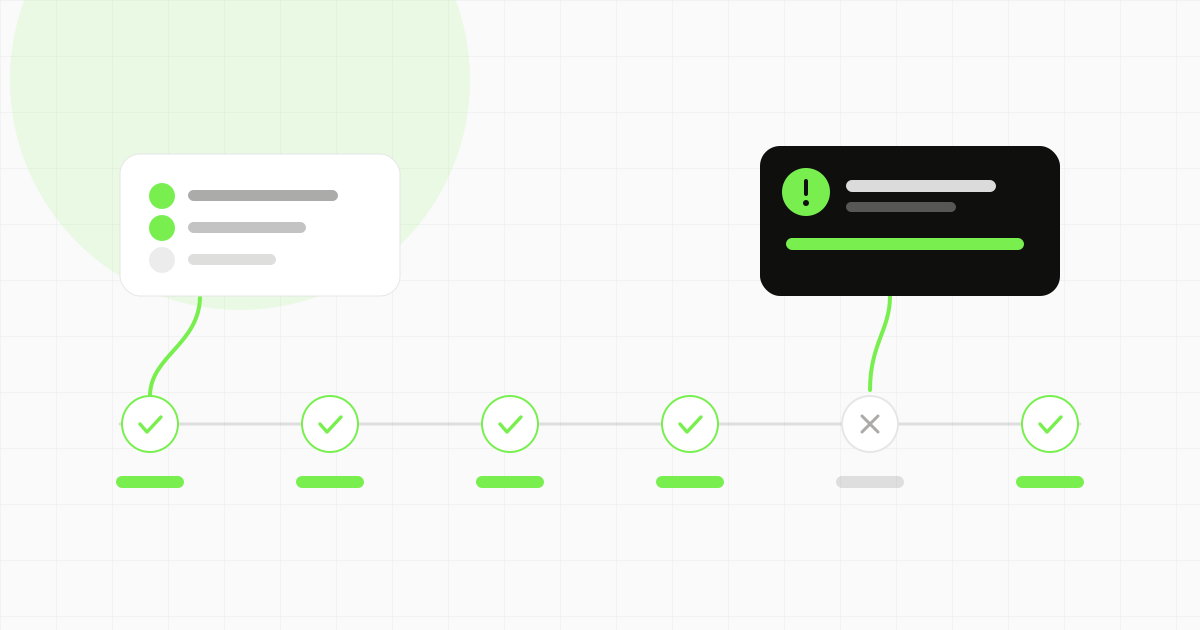
Four stages between booking and effect. The price covers the first one, only the fourth one counts.
Crawling means a crawler fetches the URL.
Indexing means the fetched page is taken into the search index.
Ranking means the page gets served for a search query.
A booked link depends on the second stage. A page that was fetched and then left out is online and absent from the index.
The difference rarely shows, because the URL answers normally in a browser. A simple link checker reports status 200 and marks the row green. Index status never enters that check.
Why a page outside the index passes on no weight
A link counts when the page carrying it belongs to the index. The mechanics behind that are covered in the article on link juice.
The link attribute changes nothing. A regular link with no rel value passes on as little from a page outside the index as a nofollow link does. Which attributes exist and what they trigger is covered in the article on the dofollow link.
What remains in this case is an article with a brand mention. Language models can pick up that mention in the text. For the link profile it has no effect.
What the evidence says about indexing new pages
Percentages circulate on this topic without any visible sample. Two evaluations from the period after August 2024 name their sample. Only one of them describes how it came about. Both only make sense read together with that sample.
How long inclusion in the index takes
IndexCheckr tracked the index status of monitored URLs for an evaluation of 16 million pages. The data is as of 28 February 2025.
The pages that made it in took 27.4 days on average. 14.00 percent stood in the index within the first week. After 30 days it was 64.86 percent. After six months it was 93.2 percent.
The last figure marks a practical limit. What is still missing after half a year rarely arrives later.
Why the 61.94 percent figure says nothing about your publisher
The same evaluation reports 61.94 percent of pages as not indexed. That number has travelled through guides ever since as a statement about the web. It describes something much narrower.
IndexCheckr gives the number of pages and the measurement period. How those pages came under monitoring is not part of it. By its own description the tool tracks URLs that users put in.
The second evaluation shows how far the values spread. Indexing Insight checked 1.7 million pages from 18 websites daily through the URL Inspection API. By the evaluation's own account, site owners submit their most important traffic and revenue driving pages there through XML sitemaps. The full page inventory of those domains is not included. The data is as of 31 March 2025. Index coverage there sits between 85 and 91 percent across brand authority classes. For e-commerce, marketplaces and listing sites the evaluation expressly reports lower values.
Both numbers are correct. They measure different sets. For the question of whether one particular publisher gets indexed, neither of them works as a forecast.
Which types of website sit reliably in the index
The Indexing Insight evaluation breaks index coverage down by type of website. The third column of the table is our own reading from practice, the evaluation itself reports only the values.
Type of website
Index coverage
What that means for a placement there
News sites
97 percent
a new article usually stands in the index within a few days
E-commerce
below 90 percent
articles in the magazine section depend on the internal linking around them
Marketplaces and listing sites
above 70 percent
an article sits next to many automatically generated pages
The evaluation assigns 88 percent of the pages outside the index to the quality category. 12 percent fall to technical causes and crawling.
67 percent of the more than 500,000 pages outside the index in the quality category carried the states "URL is unknown to Google" or "Discovered - currently not indexed". In both cases Google had not fetched the page.
For a booked placement that yields one concrete check. An article that no other page of the publisher links to often never gets fetched at all.
How to spot a publisher that gets indexed reliably
The two evaluations give ranges for whole types of website. A single booking needs a check on the actual domain.
The sample that shows the most before you book
The quickest test takes five minutes. Take the ten most recent articles from the section your placement will appear in. Search for each of those ten URLs individually on Google.
The result is a rate. In our experience nine out of ten is a good value for a trade publication. Four out of ten rules the publisher out for us.
The site:domain.com query does not give you that information. Google returns a rounded estimate there, too imprecise for a comparison. Querying the exact URL is the more reliable route.
Six checks before you book
Do the most recent articles in the section appear in search?
Is the section reachable from the home page without using the site search?
Does the publisher link new articles from an overview page, or do they sit only in the sitemap?
Does the domain have organic traffic, or does it only carry metrics?
How many outbound links stand in the most recent articles?
Has the stock of indexed pages dropped sharply over recent months?
The second and third points belong together. A page that no other page on the same domain links to is called an orphan page. It stands in the sitemap and nowhere else. Pages like that end up in exactly the states Indexing Insight reports at 67 percent.
The fifth point describes a pattern and not a verdict. A trade article with two outbound links is normal. Forty outbound links in an article of 600 words describe a different kind of publication.
On the sixth point it pays to look across several months. A publisher whose indexed stock is shrinking gives new articles little prospect either.
In our marketplace you see topic, organic traffic, SEO data and the GetMentioned Score for each publisher before you book. The sample on the recent articles comes on top, because none of these metrics contains the index status.
What a check changes about the indexing rate
Frank Olivo described for Search Engine Land how far the indexing rate spread inside his own inventory. His agency placed between 500 and 1,000 guest posts on pre-vetted websites over twelve months. 65 percent were indexed at first. After changes to the articles themselves it was 95 percent. The report appeared on 12 September 2024. Those 65 percent stood at the end of a pre-selection. A vetted domain on its own does not carry the inclusion.
The selection method behind it is not disclosed. The order of magnitude matches what we see in our own pre-check.
A booking without that check fits into one sentence. A publisher is measured by a Domain Rating of 62 and booked.
With the check the same process runs differently. A publisher is measured by a Domain Rating of 62. Ten of its recent articles are then queried individually in search. Eight of them appear. The section is linked from the home page, and the recent articles carry three outbound links each. Only then does the booking happen.
How we check indexing on booked placements
GetMentioned is an SEO platform with its own placement marketplace: analysis, content and placements for backlinks, brand mentions and digital PR in one system. Full service in link building, not full-service SEO. The check this article is about belongs to our trade, and it keeps running after publication.
Online and indexed are two different states. That is why we look at three things after publication instead of one.
Check
Question
What happens without it
Availability
Is the article still reachable?
A deleted article goes unnoticed for months
Link and anchor text
Does the link stand in the text with the agreed target?
Quiet edits to the link stay invisible
Indexing
Is the page in the Google index?
The article is online and still has no effect
The index status sits next to the live status on every booking, from order to inclusion. For agencies it doubles as evidence for their client. How the ongoing check works is described on our monitoring page.
If a placement fails within the twelve months of the link guarantee, we replace it. Failure expressly covers the case where the page is taken out of the index.
We give no promise on indexing, and nobody else can. Inclusion in the index is decided by the search engine. What we promise is publication, what we check is inclusion, and what follows a failure is a replacement.
Before I judge a publisher by its metrics, I look up how many of its last ten articles turn up in search at all, and that one number has spared me more bad bookings than a high Domain Rating ever has.
David Hahn, Managing Director, GetMentioned
What to do when a placement is not in the index
Four to six weeks after publication is the point at which the question arises. Before that the case sits inside the range the evaluation describes with an average of 27.4 days.
The order of steps for a placement without an index entry
Check whether the page is cleared for inclusion at all. A noindex in the source or a canonical pointing to another URL rules it out.
Check whether another page on the domain links to the article.
Check whether the article stands in the publisher's sitemap.
Approach the publisher with one concrete request. On a booking through us we take that over.
Swap the placement after eight weeks without a result. That is the deadline we work to.
The request in step four only carries when it names something. A message like "The article is not indexed, please take care of it" gives the publisher no problem to solve.
This is how we phrase the request, with the finding and the action. "The article cannot be reached from your section page and is missing from your sitemap. Please add it to both."
Where indexing services reach their limit
Ping services, indexer tools and paid submission services exist around this problem. They report a URL to an interface and hold out the prospect of inclusion.
The IndexCheckr evaluation carries a number on that. Of 33,930 submitted pages, 9,965 moved to the indexed state. That is 29.37 percent. The remaining 70.63 percent stayed outside the index.
The cause stays the same after a submission. A page with no internal links pointing to it drops out again even after a successful inclusion.
Anyone who books through a marketplace does not run such submissions. The route stands here as a limit, so that what it achieves is clear.
When swapping the placement is the better decision
In our experience the line at eight weeks is well placed. Until then the case is in progress. After that the missing index entry describes a property of the domain.
A publisher where two placements in a row fail to reach the index drops out of our selection. The observation carries beyond the single case. It applies to every further booking with that publisher.
What is known about how long indexed pages last
Inclusion in the index is a state that can end. The same IndexCheckr evaluation followed 310,705 pages further. 21.29 percent were taken back out of the index during the observation period. 13.70 percent of the tracked pages were hit within the first three months already.
On 26 August 2026 we searched for a survey that measures the index status of paid placements over twelve months. We found none. The available figures on how long links last come from 2022 and 2024, outside what we cite as current.
That blank is itself a piece of information. Anyone quoting a rate for index stock after a year did not take it from a disclosed survey.
What remains is your own observation over time. Index status therefore belongs in the same ongoing check as availability, described in backlink monitoring. How to record the inventory once is covered in backlink analysis.
Conclusion: index first, effect second
A paid placement has two states. It is published, and it is included. The price refers to the first state, the effect to the second.
The gap between the two can be narrowed before you book. Ten individual queries on the recent articles of one section take five minutes and rule out what no authority score reveals.
After that the ongoing check remains, because a page that was included can drop out again.
Frequently asked questions
What does backlink indexing mean?
The inclusion in the search index of the publisher page that carries a backlink. Only with that inclusion does the link become visible for the assessment of your target page.
How do I tell whether my backlink is indexed?
By querying the exact URL individually on Google. The site:domain.com query returns only a rounded estimate and is unsuited to this check.
How long does it take for a placement to reach the index?
In the evaluation of 16 million monitored pages it took 27.4 days on average. 64.86 percent of the included pages stood in the index after 30 days.
Does a backlink count when the page is not indexed?
For the link profile it does not count. The brand mention in the text remains and can be picked up by language models.
Why does a published guest post fail to get indexed?
The most common case is a page that no other page on the domain links to. It stands alone in the sitemap and often never gets fetched.
Do indexing services bring a page into the index reliably?
In the IndexCheckr evaluation 29.37 percent of the submitted pages moved to the indexed state. A submission changes nothing about the cause.
What happens at GetMentioned when a placement is not indexed?
The index check belongs to our monitoring and runs for twelve months. If the page stays outside the index, we go to the publisher, and we swap the placement when that leads nowhere.
David has been building link acquisition and digital PR processes since 2016, first as an agency under SEO Galaxy, today as a platform with GetMentioned. He has scaled his own projects from zero to seven-figure monthly traffic and delivered thousands of campaigns for clients. Here he writes about what works in practice, and about what only costs budget.
Your next link does not have to be a blind buy
Compare publishers, SEO data and prices in one place and book the placements that fit.
A link you built is not a possession. How ongoing monitoring works: what gets watched, how often, which alerts make sense and what belongs in reporting.
How to evaluate a link profile: which data you need, which metrics say something, how the competitor comparison works and what comes out as a work list.
Link juice is industry jargon for a real mechanism. Where the term comes from, why the distribution has not been steerable for over fifteen years and what counts instead.