Link juice: what sits behind the term and what still holds today
Link juice is industry jargon for a real mechanism. Where the term comes from, why the distribution has not been steerable for over fifteen years and what counts instead.
Link juice describes the idea that a link passes value from one page to the next. The image is memorable and misleading in one respect, because nothing flows. What actually happens is arithmetic.
The foundation sits in the PageRank paper by Sergey Brin and Lawrence Page from 1998. The decisive sentence states that PageRank does not count links from all pages equally and normalises by the number of links on a page. (Source: Brin and Page, The Anatomy of a Large-Scale Hypertextual Web Search Engine, 1998)
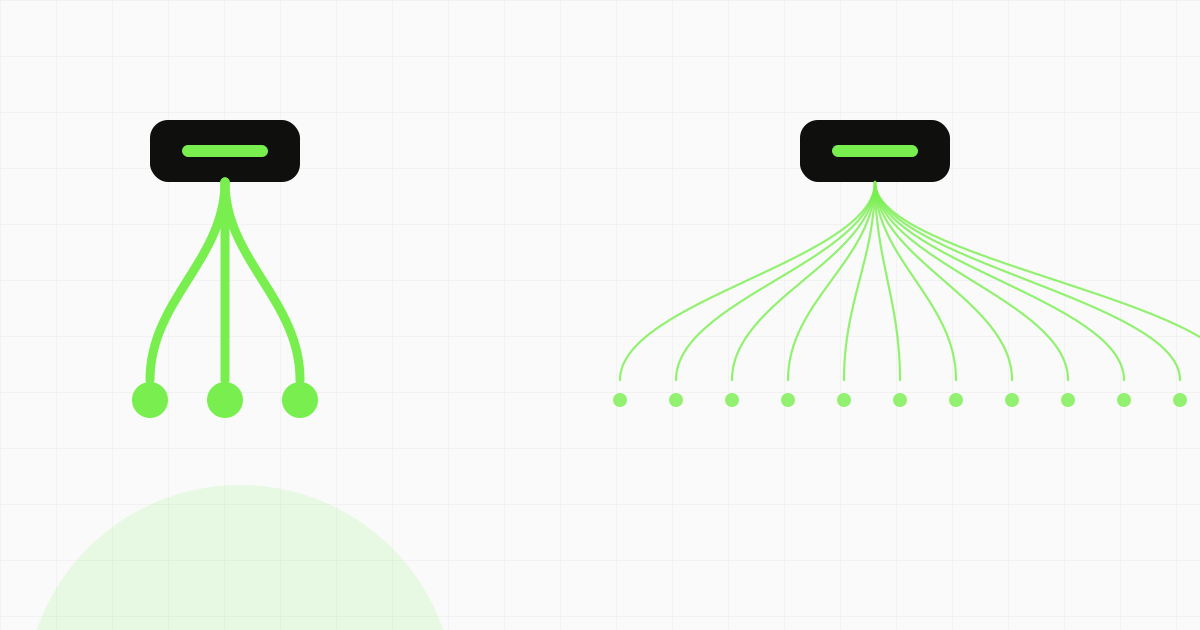
Translated: the value of a linking page is divided by the number of links it points out. A link from a page carrying three references counts for more than one from a page carrying three hundred.
A damping factor comes on top, which the authors usually set to 0.85. It models the probability that someone keeps clicking rather than stopping. In practice it means a share of the value is lost at every step.
The terms link juice and link equity appear nowhere in the original paper. Both emerged later inside the industry.
What Google says today
Two statements are documented and appear to contradict each other.
Gary Illyes wrote in 2017 that toolbar PageRank was dead and that PageRank was still used internally. That distinction matters. What disappeared was the publicly visible display, not the procedure.
From inside Google the advice over the years has been to forget most of what has been written about link juice. There is no citable source for that from the past two years, so it stands here as context rather than as evidence.
That fits together once you separate mechanism from jargon. The arithmetic exists, the popular rules built around it mostly do not hold.
What is missing from Google's current documentation is telling too. The spam policies speak of ranking signals and ranking credit; the word PageRank no longer appears there. Planning with PageRank arithmetic today means working with a model Google itself has stopped describing that way.
What happens when a page links out a lot
The arithmetic from the paper has one practical consequence. The more a page links out, the less any single link carries.
Ahrefs describes this openly for its own metric. A source domain splits its rating equally across the domains it links to. A domain rated 10 linking to three others can therefore influence your score more than a domain rated 80 linking to a million. (Source: Ahrefs, 2025)
That is a provider's metric and not Google. The direction holds regardless, and it explains why link directories and pages linking in every direction achieve little. How a single reference works in the first place is covered in our piece on how backlinks work.
Why steering link juice no longer works
There was a time when the distribution could be steered. The technique was called PageRank sculpting. Marking unimportant links on a page with the nofollow attribute made the value spread across the remaining links.
Matt Cutts made public in 2009 that Google had shut this down. Previously five links without nofollow would each have passed two points, because nofollow links were left out of the division. After the change those same five links passed one point each. (Source: Matt Cutts, 2009)
The difference sounds technical and is decisive. Links marked with nofollow still count in the denominator. Their share is simply no longer redistributed, it evaporates. Sculpting became pointless, and it had already been so since roughly 2008.
Anyone reading today that internal links should carry nofollow to concentrate strength is reading advice that stopped working more than fifteen years ago.
What you can steer instead
If the distribution inside a linking page cannot be steered, the choice of source remains. That is where the work sits.
How much else does the source link out? A page with few, editorially placed references carries more than a link list.
Does the topic match? Relevance is among the factors going beyond pure arithmetic.
Is the page indexable? What is not in the index passes nothing on.
Does the link sit in the body or the footer? Editorial context weighs more than a slot beside a hundred others.
What is the quality of the source? Metrics such as Trust Flow exist to model the trust of a domain.
Making that choice plannable is the actual lever. What such planning looks like is covered in our backlink strategy. On the GetMentioned placement marketplace publisher metrics sit side by side, so sources can be compared before booking.
Link juice is a word that outlived the mechanism behind it. Anyone still routing links to steer value is working against a calculation Google switched off in 2009.
David Hahn, Managing Director at GetMentioned
What to remember
Three things. The mechanism behind link juice exists, while the image of flowing liquid misleads. The distribution inside a page has not been steerable for over fifteen years. And what remains is the choice of source, meaning who a reference comes from and what surrounds it.
Frequently asked questions
What is link juice?
An industry term for the value a link passes to the page it points at. Behind it sits the PageRank calculation, where a page divides its value by the number of links it points out. Google does not use the word itself.
Does link juice actually exist?
The mechanism exists, the term does not. Google has confirmed it still uses PageRank internally. In public documentation Google speaks of ranking signals.
How much link juice does a link pass?
That cannot be stated as a single number. Under the original calculation the share per link falls as the source's outgoing link count rises, and the damping factor removes a portion at every step.
Can I steer link juice on my own site?
Not within a page any more. Google shut down PageRank sculpting via nofollow around 2008 and made that public in 2009. The share of links marked that way evaporates rather than being redistributed.
Do nofollow links pass link juice?
Since 2019 Google treats the attributes as a hint rather than a firm directive. Google's own wording is that such links are generally treated as before and not considered for ranking purposes.
Do links lose value across several redirects?
Every intermediate step is another step in the calculation. That is why resolving redirect chains and pointing straight at the final target pays off.
What is the difference between link juice and link equity?
Practically none. Link equity is the more sober expression for the same idea. Both terms come from the industry rather than from Google.
David has been building link acquisition and digital PR processes since 2016, first as an agency under SEO Galaxy, today as a platform with GetMentioned. He has scaled his own projects from zero to seven-figure monthly traffic and delivered thousands of campaigns for clients. Here he writes about what works in practice, and about what only costs budget.
Your next link does not have to be a blind buy
Compare publishers, SEO data and prices in one place and book the placements that fit.
A backlink works in four steps: discovery, attribution, evaluation, effect. What happens technically, what decides its weight and what a link explicitly does not do.
Trust Flow looks like a decision number, and that is exactly the problem. How the Majestic metric is built, what counts as a good value, and which decisions you can actually take from it.
Link building rarely fails on method, it fails on missing prioritisation. Nine steps from analysis through target pages, assets and publishers to measurement, with a scorecard, a 90-day roadmap and a KPI set.