Building a backlink strategy: authority you can plan for
Link building rarely fails on method, it fails on missing prioritisation. Nine steps from analysis through target pages, assets and publishers to measurement, with a scorecard, a 90-day roadmap and a KPI set.
If your content is strong and the rankings still will not move, another article is rarely what is missing. Usually what is missing is external authority and a plan that steers it. What decides it is not the largest possible number of backlinks but relevant signals: fitting publishers, topical mentions and links to the pages that are actually meant to grow.
A good backlink strategy does not start with outreach, it starts with prioritisation. Four questions come first:
Which target pages should rank better?
Which publishers fit those topics?
Which of your content is worth linking to at all?
How do you measure the effect, if not by link count?
This guide lays the build-up out as a system: from analysis through target pages and assets to publisher selection, execution, measurement and optimisation. Not a collection of individual tactics but a decision logic.
What a backlink strategy is, and what it is not
A backlink strategy is a plan that sets out which pages need external authority, which content serves as linkable assets, which publishers fit topically and how quality, risk and effect are measured. It directs external links and mentions to prioritised target pages so authority builds by plan rather than by accident.
Building authority does not mean collecting as many backlinks as possible. It means deliberately building external trust signals around your important topics and offers: high-quality backlinks, brand mentions, digital PR, editorial references and recurring presence in the relevant professional settings.
Link building and a backlink strategy are not the same thing. Link building describes the operational measures: guest articles, digital PR, partner links, link reclamation, broken link building. The strategy is the steering layer above it. It settles beforehand which URLs need signals, which publishers fit, which quality criteria apply, which risks are ruled out and what the effect is measured against.
Without that layer, link building stays piecemeal. Individual links appear, but they do not automatically feed rankings or growth.
Why backlinks count for rankings and visibility
Backlinks help search engines place relevance, authority and trustworthiness. When other websites point to your content, products or expertise, an external signal appears: this page is relevant enough to be used as a source.
What decides it is not only that a link exists, but where it comes from, what context it sits in and which target page it points to.
A backlink works through three factors: where the source comes from, the context of the placement and the target page it points to.
Backlinks do not produce better rankings on their own. They work together with content quality, technical setup, internal linking and search intent. A strong link to a weak or ill-fitting target page therefore usually does less than a relevant link from the right topical setting to a page with real ranking potential.
Why this matters more for AI visibility
People increasingly find information through more than classic search results. AI Overviews, AI Mode and generative answer systems summarise content, compare providers and favour sources that are recognisable across the web as relevant, trustworthy and topically clear.
Google's own review one year after AI Mode launched puts it past a billion monthly active users worldwide. An AI Mode query there runs on average three times the length of a traditional search query, and more than one in six searches in the US uses voice or an image. That gives external mentions, quotable content and a clear topical assignment more weight.
Google describes AI Overviews and AI Mode as generative features inside Search and stresses at the same time that the fundamental SEO practices still apply to them. When a brand is regularly named and linked in fitting trade articles, industry media, studies or interviews, a clearer picture emerges of which topics it is credible in.
For the strategy that means it should not only improve individual rankings but make the brand visible in the right topical settings. External sources have to show consistently what the brand stands for.
Why link building without prioritisation fizzles out
Plenty of teams start with the wrong question. They ask: where do we get backlinks fast? The more useful question is: which pages, topics and assets deserve external authority?
The most common misconception is that more links automatically lead to better rankings. In practice a single link from a trusted trade publication can be worth more than many references from irrelevant directories. But it is equally true that a single mention is not enough.
Typical problems without a strategy:
Links land on the wrong target pages
Publishers do not fit the target page topically
Anchor text looks unnatural or over-optimised
Linkable assets are missing entirely
Outreach costs a lot of time and stays unstructured
Success is measured on link count alone
Backlinks are thought about separately from content, internal linking and topic clusters
The result is isolated wins but no link profile that holds up.
When you need a strategy
In our experience it pays off most for companies that have already built content and topic clusters and now want to steer the external signals more deliberately. Typical situations:
Your content ranks in positions 5 to 20 and does not make the jump
Competitors have a clearly stronger link profile
New money pages, product or service pages need to become more visible
Your brand barely appears in AI answers while competitors do
A topic cluster is meant to build authority systematically
A relaunch or product launch is coming up
Outreach is already running but without a target-page and quality logic
Link building needs to scale without tipping into risky patterns
It makes less sense as a first step when technical problems, unclear search intent or weak content are the real cause. Then onpage work, content and internal linking belong in order first, otherwise you are building on a foundation that does not carry yet.
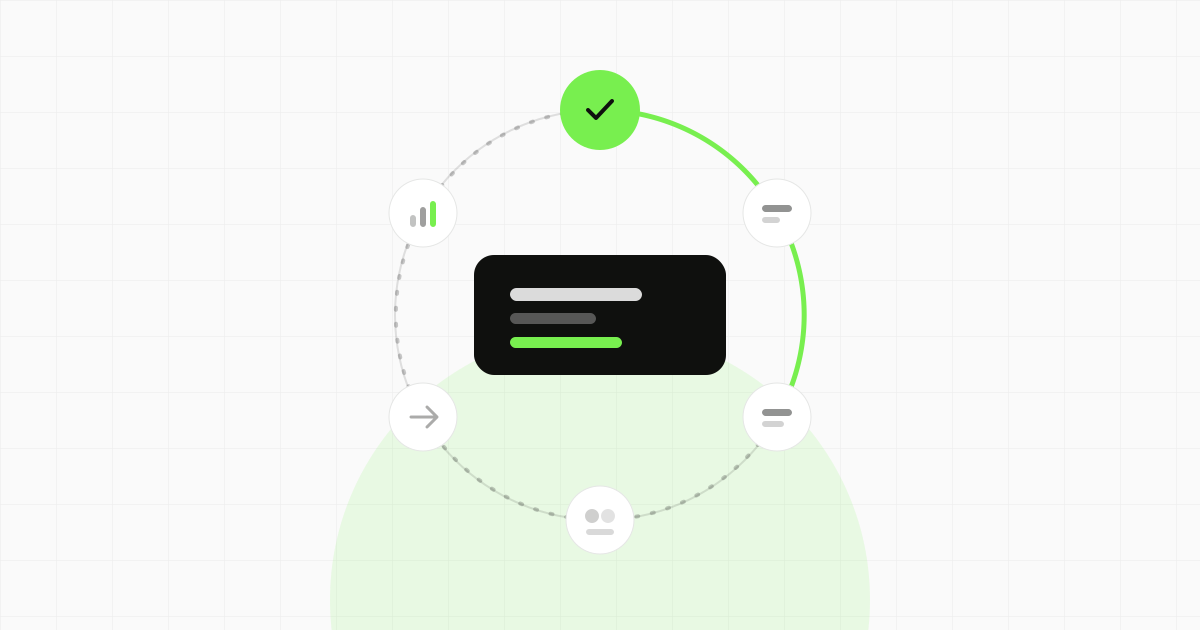
The strategy as a cycle
The sequence is not a one-off project. You analyse the starting position, prioritise target pages, develop assets, select publishers, execute, measure the effect and optimise the process. Then the round starts again, with better data.
From the starting position through target pages, assets, publishers and execution to measurement and optimisation.
The nine steps
Step 1: analyse the starting position and link profile
The analysis needs clean data. Tools like Ahrefs, Semrush, Sistrix or Majestic show link profiles, referring domains, anchor text and competitors. Google Search Console adds Google’s own view.
Combine several sources, because no tool maps the whole web. Ahrefs and Semrush work well for competitor comparison, Search Console is indispensable for checking your own links and linked target pages from Google’s point of view. Eight questions guide the audit:
Which pages already receive backlinks?
Which target pages have ranking potential but too few external signals?
Which topic clusters are strong internally and weak externally?
Which competitors have more relevant referring domains?
Which publishers link to or mention competitors?
Are there brand mentions without a link?
Are there lost links that can be won back?
Are there risky or off-topic links in the profile?
A disavow file belongs to clear risk cases only: when problematic links cannot be removed and a real pattern of damaging links is visible. Disavowing as a precaution does harm more often than good.
Step 2: prioritise target pages
The strategy only becomes steerable once it is clear which pages need link building at all. Prioritisation means bringing business value, ranking potential, link gap and the fitting asset together for each page.
Not every URL makes a good link target. Some pages matter for revenue but are hard to link to. Others are highly linkable and only pay in indirectly. A good strategy connects both levels through internal linking: external links to a strong guide, a study or a tool, and from there the authority passes on to product, category or service pages.
Page type
Business value
Ranking potential
Link gap
Fitting asset
Priority
Money page
high
medium to high
high
Comparison, case study, industry report
1
Category or product page
high
high
high
Buying guide, test data, use case
1
Guide hub
medium
high
medium
Study, checklist, data analysis
2
Glossary or fundamentals
low to medium
medium
low
Definition, visualisation
3
Established websites follow a different logic from new domains. Existing sites can strengthen individual guides, product pages or assets in a targeted way. New domains first have to build trust, first mentions and basic topical authority.
Step 3: analyse competitors and the link gap
A link gap analysis shows more than who has more backlinks. It shows where external authority is created in the market at all. Seven questions structure the comparison:
Which competitors rank better for your most important keywords?
Which of their pages get particularly many links?
Which publishers link to several competitors at once?
Which content formats generate links there?
Which topic areas are already taken externally?
Which link sources are missing from your profile entirely?
Which of those publishers would be relevant for your brand too?
Important: this is not an invitation to copy, it is market analysis. You see which publishers, topics and formats create authority in your market and derive your own strategy from that.
You recognise a strategy by what it says you will not do.
David Hahn, Managing Director, GetMentioned
What counts here is not only direct business rivals but every website visible for your important keywords and decision questions. Often those are trade media or comparison portals you never meet as competitors in the market.
That comparison is what MentionIQ takes off your hands: the analysis puts your website, your competitors and your most important keywords side by side and shows which link sources and topical settings are still open.
Step 4: develop linkable assets
Assets are the bridge between content and offpage work. Without content worth linking to, outreach comes across as artificial. Backlinks rarely appear because you write to a website. They appear when you have something worth pointing to.
So every prioritised target page needs a reason to be linked. A pricing page is rarely worth linking to, the data analysis, the benchmark or the checklist next to it is. Assets do not have to be elaborate, they have to be quotable: your own numbers, a clear argument, a tool that takes work off someone’s hands.
Linkable assets can be thought of in three groups: data, practical tools and formats that give context.
Studies: your own research or analyses that deliver new findings
Data analyses: examinations of existing data sets, markets or developments
Industry reports: overviews of trends, changes and benchmarks
Benchmarks: reference values and averages others can orient themselves by
Tools and calculators: applications that solve a concrete problem
Templates and checklists: documents ready to use and step-by-step overviews
Comparison content: products, methods or approaches set against each other
Frameworks: structured models that make complex topics understandable
Expert assessments: professional judgements from people with demonstrable expertise
Original data and visualisations: numbers you collected yourself and graphical presentations
The most important check question: why should a publisher link to exactly this content? If you have no strong answer, link building turns into a volume game. Then you need more emails, more follow-ups and more deals, and you do not get more authority.
Step 5: select publishers
Publisher fit decides more often than any single domain metric. A strong domain is not a good place to be linked from when topic, audience and context do not fit. A publisher that fits everything fits nothing. Metrics help, but they do not replace a qualitative check. Seven criteria belong on the scorecard:
Criterion
Check question
Topical relevance
Does the website fit the target page and the cluster?
Audience fit
Does the publisher reach the right readership?
Editorial context
Is the link embedded sensibly in the content?
Visibility
Does the website have real rankings and organic traffic?
Trustworthiness
Does the website look editorially maintained and serious?
Outbound link patterns
Does the website link out conspicuously often?
Placement
Does the link sit in the body text or only in a side area?
So the selection does not hang on a single figure, the GetMentioned Score pulls relevance, price performance, authority and likely effect for each publisher into one rating. In practice we see teams mainly sorting out faster with it: the ill-fitting placements drop out earlier. As a placement marketplace you then compare publishers, SEO data and prices in one place and book the fitting placement directly.
Step 6: judge methods by goal and risk
Not every method fits every goal. Digital PR works differently from guest articles, link reclamation serves a different purpose than sponsored posts, broken link building needs different assets from interviews.
Method
Suited to
How to read it
Digital PR
Data, studies, strong arguments, brand building
Good for natural mentions and high-quality links
Guest articles
Expertise, thought leadership, building out a topic
Easy to steer when editorially strong
Interviews
Personal brand, trust, positioning in the industry
A natural format for mentions
Sponsored posts
placements you can plan
Only worthwhile with quality, transparency and topical relevance
Buying backlinks is often understood as a blanket forbidden practice. That falls short. In its spam policies Google targets link practices meant to manipulate rankings artificially. What is problematic is therefore not paid placements as such but unnatural patterns: irrelevant domains, bulk packages, networks, over-optimised anchor text or placements without editorial context.
In practice paid placements, sponsored posts, interviews or digital PR publications can be a sensible part of the strategy. What decides it is that the piece fits the publisher’s audience, offers real informational value and is not merely a carrier for a link. The point is not whether money changed hands but whether the placement holds up in quality and topic.
Link reclamation: existing chances first
Often the fastest lever, because you do not have to build new relationships but use visibility that already exists. Five typical cases:
Your brand is mentioned but not linked
A link points to a wrong or outdated URL
An earlier link has been lost
A piece of content was moved and needs a redirect
A publisher uses an old source although a better one exists
Anchor text and link attributes
A natural profile consists of brand anchors, URL anchors, generic phrasings and topical variants. Exact anchors on money keywords belong in sparing use, because repeated identical anchor text quickly looks like a pattern.
Do not aim the strategy exclusively at follow links either. Nofollow, sponsored and UGC links can be worthwhile when they bring traffic, create mentions or come from relevant settings. And referring domains say more than raw link count. Many links from the same domain weigh less than references from several independent sources. Track them per target page and cluster, then, not only for the domain as a whole.
Step 7: quality as an exclusion criterion
A strategy defines not only which links get built but also which stay deliberately excluded. Quality criteria are the guard rails that stop link building from looking good in the short term and creating risk in the long term.
A relevant source with fitting topical context
Editorial embedding instead of a link list
Natural anchor text
A visible, maintained website with real content
No recognisable link network
Plausible link growth
A mix of different link types
Documentation of every placement
Typical risk patterns are the counterpart: many links in a short time with no reason anyone can follow, irrelevant websites, over-optimised exact anchor text, packages without a quality check, sites without organic visibility, manipulative networks and links to the wrong target pages.
For every placement, record which anchor text went to which target page and which campaign it came from. Without that note you can neither attribute effect later nor spot patterns in your own profile.
Step 8: a roadmap for 90 days
So the strategy does not get stuck in “we should really”, it needs clear results per period:
First data on quality, rankings and referral traffic
The pace should look organic. Sudden jumps in the number of new links look unnatural, especially when no traceable activity like digital PR, a product launch or a study explains them. Link velocity is therefore not a goal along the lines of “as fast as possible” but a control signal.
Step 9: measure the effect
The strategy only scales when you measure not the number of links but the effect along visibility, quality and business goals.
KPI
What is measured
Why it counts
Referring domains
Number and quality of the linking domains
Shows whether authority is broadening
Link quality
Relevance, visibility, trust and context
Judges whether links make strategic sense
Ranking development
Change in the target pages’ rankings
Shows whether the right pages are getting stronger
Referral traffic
Visitors arriving through external links
Shows whether placements reach real people
Brand mentions
References even without a link
Rounds out the picture of external visibility
Link velocity
The pace of link growth
Helps separate natural development from risk
Lost links
links removed or no longer reachable
Shows where the profile needs maintenance
Indexing of placements
whether the published piece made it into the index
A link that is not indexed simply does nothing
Anchor text distribution
The ratio of brand, URL and exact anchors
An early warning system for unnatural patterns
Enquiries and deals
Effect on business goals
Connects link building to commercial value
The connection to the target page stays decisive. A new link is an interim result. What counts is whether the strengthened URL ranks better, reaches more relevant people and feeds enquiries more strongly.
Common mistakes
The most common mistake is starting outreach before target pages are prioritised. The second most common is looking at bare domain metrics: Domain Rating or Domain Authority can help, but on their own they say nothing about whether a link carries strategically.
Six mistakes that reliably slow the build-up down, whatever the budget.
Building links to pages with no business value
Ignoring topical relevance and selecting on reach
Using too many exact anchor texts
Booking paid placements without a quality and context check
Neglecting linkable assets
Running no competitor analysis
Measuring success on link count alone
Not documenting lost links
Rating publishers once and never checking again
Treating onpage and offpage work separately
Approaching publishers with generic outreach emails
Not connecting content strategy and link building
Checklist: is your strategy ready?
Are the most important target pages prioritised?
Is the link gap against competitors known?
Is there at least one asset per important topic cluster?
Are the fitting publisher types defined?
Are there clear quality criteria?
Are risky link sources ruled out?
Is there an anchor text logic per target page?
Are links, mentions, rankings and referral traffic measured?
Is there a roadmap for the next 90 days?
Is it clear which system carries the operational work?
If you cannot answer several of these with confidence, that is no problem. It only shows the strategy is not set up as a system yet.
In closing
A backlink strategy ties target pages, assets, publisher selection, quality checks and monitoring into a repeatable process. Work that way and you direct external authority to the pages that count for rankings and growth. Not every page needs backlinks, but the right pages need the right signals. Anyone who wants to be found for their own topics and named as a source in AI answers builds external authority exactly there. Compare suitable publishers before budget moves. Create your free account.
Common questions about backlink strategy
What is a backlink strategy?
A structured plan for building relevant external links and mentions in order to strengthen your website’s authority, trust and organic visibility.
How do you develop a backlink strategy?
You analyse the current link profile, compare competitors, prioritise target pages, develop content worth linking to and build mentions and backlinks on that basis.
What separates link building from a backlink strategy?
Link building is the operational sourcing of links. The strategy defines goals, priorities, target pages, methods, quality criteria and success measurement beforehand.
Which backlinks are valuable?
Links from topically relevant, trustworthy sites with real editorial context, sensible placement and the prospect of actual traffic.
Which pages need backlinks?
Priority goes to pages with business value, ranking potential and a visible link gap. Those can be money pages, guide hubs, category or product pages as well as important assets.
Which content works for backlinks?
Above all linkable assets: studies, data analyses, industry reports, tools, calculators, templates, checklists, frameworks, comparisons and visualisations.
Should you buy backlinks?
Paid placements become risky when they are built unnaturally, in bulk or without relevance. What decides it is topical relevance, editorial embedding, transparency and a natural mix. Manipulative networks and pure link packages without checks belong ruled out.
How many backlinks do I need?
There is no universal number. What decides it is which pages should be strengthened, how strong the competitors are and how relevant the links actually are.
How long does a strategy take to work?
That depends on competition, domain authority, content quality and link sources. Backlinks are rarely an instant lever, they are part of a long-term development.
How do I measure success?
Through referring domains, link quality, the ranking development of the target pages, referral traffic, brand mentions, link velocity and the effect on enquiries or deals.
What role does the strategy play for AI visibility?
External mentions, backlinks and publisher placements help make a brand more visible and more trustworthy in particular topic areas. AI systems use signals like these to place sources. What decides it is not individual links but consistent mentions in credible contexts.
David has been building link acquisition and digital PR processes since 2016, first as an agency under SEO Galaxy, today as a platform with GetMentioned. He has scaled his own projects from zero to seven-figure monthly traffic and delivered thousands of campaigns for clients. Here he writes about what works in practice, and about what only costs budget.
Your next link does not have to be a blind buy
Compare publishers, SEO data and prices in one place and book the placements that fit.
When rankings stall despite good content, external authority is usually what is missing. Seven steps from prioritising target pages to measuring the effect, with a method comparison, anchor text spread and the KPIs that show what worked.
Backlinks are digital recommendations. What they are, how search engines weigh them, which types exist and why good content alone is rarely enough. With numbers from two analyses.
Tool comparisons usually end up as feature lists. This overview sorts the tools by the bottleneck they solve instead: prospecting, outreach, placement or monitoring.