Building backlinks: step by step to external authority
When rankings stall despite good content, external authority is usually what is missing. Seven steps from prioritising target pages to measuring the effect, with a method comparison, anchor text spread and the KPIs that show what worked.
When your rankings stall despite good content, the problem usually sits with external authority. Link building is the off-page piece that complements content, technical work and internal linking. Google, Bing and AI systems read those external signals to place relevance, trust and topical authority.
Anyone who wants to build backlinks without getting lost in outreach, unclear pricing and inconsistent quality has to treat link building as a repeatable process. That takes standards for selection, execution and control. Those are what follow.
When building backlinks pays off and when it does not
Which conditions your website should meet beforehand
How to spot and pick high-quality link sources
Which methods work today, with effort and risk compared
Which mistakes reliably cost you the effect
How single placements turn into a process that scales
Building backlinks as part of off-page optimisation
Building backlinks means creating external references and mentions on purpose. They strengthen authority, relevance and trust. A good backlink works like a vote of confidence, because another website points to your content, your brand or your expertise.
In practice we see backlinks, brand mentions and editorial references strengthen brand authority together. Search engines and AI systems use those signals to place relevance and topical proximity. Link building therefore strengthens both: classic visibility in search, and the question of whether a brand gets pulled in as a source by AI systems.
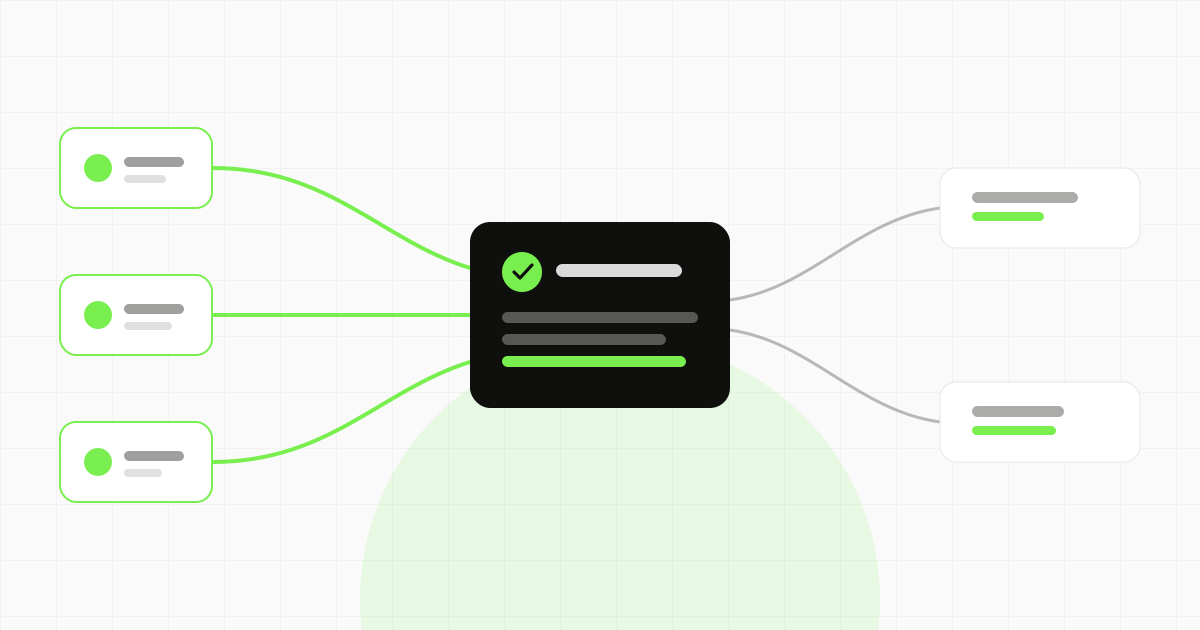
A reference from an external website strengthens three signals at once. Search engines and AI systems read them together.
When link building pays off, and when it does not
Link building works once the foundation stands. These situations argue for it:
You have good content but trail competitors on authority
You want into contested results and are aiming for the front positions
You want to push new money pages, services or topic clusters
Your pages sit at position 11 to 30 and the final push is missing
Your brand barely appears in the relevant sources of your market
It makes less sense while technical or editorial basics are missing: indexing, search intent, internal linking, content quality. Then links only amplify a system that does not yet carry internally. In our experience that is the most common reason campaigns move nothing: the budget was right, the timing was not.
What has to be in place before you start
Three things have to stand before the first link: a clean technical base, content that survives the comparison, and measurability. Without the third you can build links, but you cannot judge whether they strengthen the right target pages or only create volume.
Prioritised target pages and quality criteria for publishers matter just as much. Without both you get links that do little in the long run and, in the worse case, weaken the profile.
The seven steps
Step 1: prioritise target pages
Prioritise on three questions instead of starting with the obvious:
Business impact: which pages pay straight into enquiries or revenue?
Ranking potential: where is a jump realistic with a few strong links? Position 5 to 20 is usually the best range.
Linkability: which page has a natural reason to be linked at all?
In our experience the biggest effect comes when links point at a strong asset and the authority is passed on internally from there. That strengthens money pages indirectly instead of linking hard to product pages, which rarely gives an editor a reason to link.
Step 2: analyse the link gap and your competitors
For each target keyword, analyse which domains rank ahead of you, how many relevant referring domains their ranking URLs have, and which websites link to several competitors at once. The goal is a realistic reference point for how much authority is actually needed.
Looking at successful link profiles also shows which formats really build authority in your market: studies, tools, guest articles or digital PR. Competitors here are not only your direct business rivals, but every website visible for your keywords. That comparison is exactly what MentionIQ takes off your hands: the analysis puts your website, your competitors and your most important keywords side by side and shows which link sources and topical settings are still open.
Check the existing profile in the same pass. Conspicuous patterns such as many off-topic links, identical anchor texts, sudden link spikes or domains from networks belong documented and classified. Individual weak links are normal background noise and no reason to act. Action is only needed once unnatural patterns recur.
Google’s disavow tool belongs in clear problem cases only, so with visibly manipulative links or a manual action. Devaluing domains as a precaution does more harm than good more often than not.
Step 3: prepare linkable assets
Without a reason to link, link building gets expensive and slow. Linkable Assets are content that works as a source: studies, data analyses, reports, in-depth guides, calculators, templates, checklists and infographics. They give editors a concrete reason to mention you.
Step 4: research suitable publishers
The evaluation should go beyond domain metrics. What decides it is topical relevance, organic visibility, editorial quality and above all the pattern of outbound links: does this look like editorial work or like link selling?
So the selection does not hang on a single metric, the GetMentioned Score pulls relevance, price performance, authority and likely effect per publisher into one rating. In GetMentioned as a placement marketplace you then compare publishers, SEO data and prices in one place and book the fitting placement directly.
Anyone who wants to scale needs a curated list with clear priority instead of a growing collection of one-off finds. That reduces waste and makes the selection traceable across the team.
Step 5: choose a method
Our experience shows that a single method rarely makes the difference. It is the mix, matched to target page, asset and industry. A clean method mix also lowers the risk, because the profile does not grow out of one single source.
Which method suits what, and what to expect in effort and risk, is in the method comparison further down. For planning, one decision is enough to start with: two or three methods that fit your asset and your industry, instead of testing all of them at once.
Step 6: execution
Whether manual outreach or direct placement: it takes briefings, standards and documentation. Define upfront which target page gets linked, which context fits, which anchor texts are candidates and what is ruled out.
In outreach, templates are only a starting point. A good request answers four things briefly:
Why does the content fit this website?
What value does it add for their readers?
Where would a link sit sensibly?
Why does your asset work as a source?
Generic mass mails do not work. In practice we see reply rates rise as soon as it is clear that someone actually read the publisher’s content and knows their audience. If you do not want to run the process yourself, you can hand it over: from the analysis through publisher selection and content to booking, reporting and adjustment.
Step 7: check and measure the effect
Check every link individually: is it live and indexable, does it sit in the right context, does it point at the right target URL, does the anchor text read naturally and are the link attributes right?
After that you connect the link data with rankings, clicks and impressions from Search Console, organic traffic and enquiries. Link building only turns professional at this point: when it gets checked, learned from and adjusted.
Method comparison
Which method makes sense depends on target page, asset, publisher fit and how predictable you need it to be. The table shows what suits what and what to expect in effort.
The most expensive mistake in link building is not the bad link. It is the good link pointing at a page that sells nothing.
David Hahn, Managing Director, GetMentioned
Method
Suited to
Requirement
Risk
Effort
Digital PR
brands with strong assets
data, story, pitching
medium, because it is hard to plan
very high
Guest articles
thought leadership, building clusters
good authors and briefings
low to medium
medium
Broken link building
quick placements
a strong replacement asset
low
medium
Link reclamation
using existing mentions
mentions without a link
low
low
Resource lists
tools, guides, overviews
clear practical value
medium, quality varies
medium
Skyscraper
heavily contested topics
content clearly better than what exists
medium
high
Roundups
expert positioning
subject knowledge and relevant contacts
low
low to medium
Expert interviews
personal brand and PR
expertise and a fast response
low
medium
Partnerships
B2B, SaaS, ecosystems
genuine cooperation
low
medium
Directories, selective
local and industry-specific signals
curated directories
medium
low
Listicles
tools, providers, comparisons
research and transparent rating criteria
medium to high
medium to high
A word on listicles: they can make sense when a tool or a service genuinely belongs in a curated overview. An analysis by Lily Ray classes self-promoting best-of lists as an increasingly risky tactic, though, especially when providers put their own solution at number one without a traceable methodology.
The format only holds up with real research, disclosed rating criteria and a fair assessment of the providers named. A good listicle helps with a decision and explains why a solution was included.
Practical levers in link building
Steering anchor texts naturally
Anchor texts help search engines and readers place the context of a link. Brand and URL anchors plus naturally phrased topic anchors should lead. Exact money anchors quickly look like a pattern when they turn up too often.
As orientation for an unremarkable profile:
50 to 70 percent brand or URL, so brand name, domain or product name
20 to 40 percent semantic or partial match, such as “link building guide”
10 to 20 percent exact match, when it reads naturally in the sentence
This spread is not a law. In some industries the exact anchors of the competitors at the front sit at 60 to 70 percent. So: analyse the profile of the domains that rank for your keywords first, then set your own spread. What stays decisive is readability, a good anchor text fits into the sentence and describes the target.
Using broken link building deliberately
The method suits you when you can offer a strong replacement asset for a dead source. It works particularly well with resource pages, old studies, discontinued tools and outdated guides. A short check pays off before the pitch:
Does your asset really match the original source?
Is the publisher topically relevant?
Does your replacement add genuine value?
Can the link sit naturally in the existing context?
If the fit is missing, do not send the request. Broken link building only works when you solve a concrete problem for the publisher.
Distributing assets actively
An asset rarely attracts links on its own. The right channel depends on the format: studies, reports and data analyses belong with trade media and in digital PR. Calculators, templates and tools fit resource pages and practical articles. Assessments and frameworks work in guest articles and interviews.
What decides it is the value for the individual publisher. A study delivers new data, a calculator makes a task easier, a checklist makes a process usable. The clearer that value, the more traceable the link looks.
Which backlinks you should actually build
A good backlink is topically relevant, editorially embedded, technically clean and comes from a place with real visibility. One link like that is often worth more than twenty weak ones. Five points belong checked before every placement:
Topical relevance: the website covers similar topics and speaks to a fitting audience
Trustworthiness: established sources weigh more than unknown or questionable surroundings
Editorial context: links in body copy carry more weight than footer, sidebar or link list
Visibility: real rankings, real visitors, real content instead of pure link pages
Natural placement: the link is traceable for readers and justified by the content
The five criteria take a few minutes per publisher and save the expensive correction afterwards.
What you should avoid
Pointing everything at the homepage while the money pages stay empty
Filtering on a single metric, usually Domain Rating
Consistently exact money anchors, or consistently only the brand
Never checking after publication whether the article got indexed and stays online
Cheap packages without editorial context and without a traceable source
Link farms and private networks, even when the metrics look good
Speed is a point of its own. When a profile jumps from zero to two hundred links without brand, traffic or content growing with it, that looks implausible. Build continuously and orient yourself on what is normal in your market.
Scaling without losing quality
Link building does not scale through more volume but through fixed processes. Six points decide whether the effect grows with the volume or only the workload:
Publisher criteria: which websites qualify, which are ruled out?
Briefing standards: which details on target page, topic, anchor text and context does every article need?
Documentation: where do placement, link target, anchor text, status and date live?
Quality check: who reviews publisher, content, link position, indexability and attributes?
Monitoring: how are rankings, referring domains, traffic and enquiries tracked after publication?
Learnings: which publishers, formats and target pages deliver good results repeatedly?
Without those six points, link building organises itself through single emails, scattered spreadsheets and decisions in chat. That is exactly where scaling fails, not on budget.
Which KPIs show what worked
In our experience link building gets judged too superficially. Many teams look first at the number of new links or at a single domain metric. It only becomes meaningful in the combination of link quality, topical fit, target-page performance and commercial effect.
KPI
What you check
Why it counts
Relevant referring domains
Which new domains link, and do they fit the target page topically?
Shows whether authority is building through relevant sources
Publisher quality
Does the website have visibility, editorial substance and a natural link pattern?
Separates strong placements from risky sources
Domain Rating, Ahrefs
Is the value trending upwards over the period?
An indication of whether the profile is gaining strength
Domain Authority, Moz
How does the value change over time?
A second perspective on domain authority
Trust Flow and Citation Flow, Majestic
Are quality and strength of the profile developing coherently?
Shows whether new links are trustworthy or merely numerous
Visibility Index, Sistrix
Is visibility rising for the website and the important target pages?
Connects link building with organic presence
Rankings of the target pages
Are the keywords of the linked URLs improving?
Shows whether the authority lands on the right pages
Clicks and impressions
Are the values rising in Search Console?
Connects link building with real search demand
Mentions in AI Overviews
Does the brand get named in AI-assisted results?
Shows whether external signals raise visibility in AI answers
Sources in AI systems
Do ChatGPT, Perplexity, Gemini or Claude pick up your content as a source?
Rates source presence outside classic rankings
Brand mentions and brand searches
Is the brand named more often or searched for directly?
Shows whether the work also creates demand
Referral traffic
Does the placement bring real visitors?
Checks whether placements reach people
Enquiries and deals
Does the work produce enquiries, accounts or revenue over time?
Connects link building with commercial effect
Link stability
Do links stay online, indexable and in a fitting context?
Makes sure the authority built stays in place
These values come together in the GetMentioned dashboard: booked placements, linking publishers, strengthened target pages and the status of the publications. On top of that, how your own metrics develop over time, so progress can be evidenced internally or to clients.
In practice single strong links rarely trigger immediate jumps. They stabilise target pages step by step. So link building belongs judged over several months and not after one single campaign.
Thinking backlinks, content and topical authority together
Links work best when they match the content structure. Check three things with every placement: which topic cluster is meant to get stronger, which asset takes the external link, and which money page benefits from it through internal linking?
That turns link building into an amplifier for topical authority. External links strengthen a relevant asset, internal links spread the authority through the cluster, and recurring presence with topically relevant publishers supports trust and rankings.
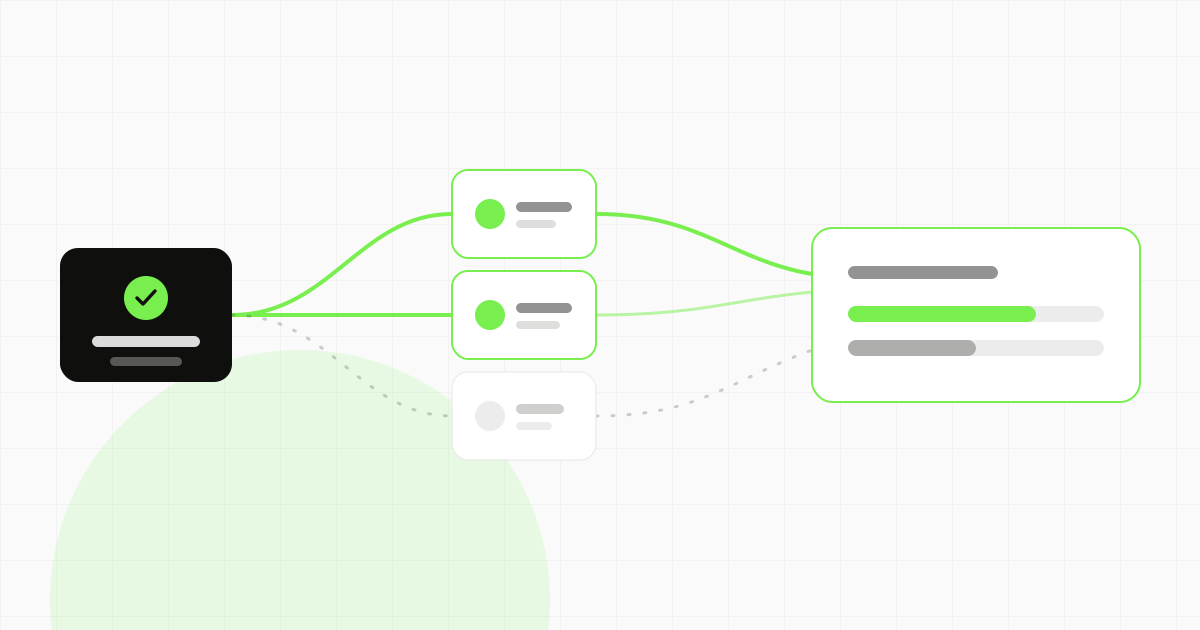
External links run into a strong asset, from there internal linking spreads the authority through the cluster.
Checklist: are you ready?
If you answer several points with no, structure is still missing before you scale:
Are the most important target pages prioritised?
Do you know your link gap?
Are the technical setup and indexing clean?
Is the internal linking built sensibly?
Is there a linkable asset or a clear reason to link?
Are publisher criteria and an exclusion list defined?
Is the anchor text spread set?
Is every link documented?
Are KPIs for rankings, traffic and enquiries live in the reporting?
Is there a process for follow-up checks and optimisation?
In closing
Building backlinks means developing authority predictably instead of collecting links. The order decides it: target pages and gaps first, then assets, then selection and execution, control at the end. In our experience most programmes fail on step 1 and step 7 being missing. Anyone who wants to be found for their own topics and named as a source in AI answers needs placements with publishers that are up to it. Compare them before budget moves. Create your free account.
Common questions about building backlinks
Which method suits a start?
Link reclamation, so having existing mentions without a link turned into links after the fact. The effort is small, the risk low, and you learn along the way which publishers write about you at all. Guest articles and selected editorial placements usually follow.
How do I start without a strong asset?
With editorial placements at topically relevant publishers. In parallel you build the first asset, often an existing guide or comparison can be expanded into one. Building an asset first and only then starting costs months you do not need.
How long does it take for backlinks to work?
First publications are possible within days to weeks. Ranking effects usually take three to six months, longer in contested surroundings. Expecting results after four weeks means measuring too early.
How many backlinks do I need?
Only the comparison with the domains that rank for your keywords answers that. There is no absolute number: in a niche a few strong links are enough, in contested markets the reference point sits considerably higher.
Which mistakes cost the most effect?
Links to the wrong target pages, irrelevant publishers, mass outreach, missing assets, over-optimised anchor texts, unnaturally fast growth of the profile and no monitoring after publication.
Are backlinks still important?
Yes, and they now work on two levels. Alongside classic rankings, external mentions help decide whether AI systems treat a brand as a source. Both levels feed off the same signals.
Can I buy backlinks as well?
Placements with publishers can be booked, that is normal in the market. What decides it is what you buy: an editorial embedding on a domain with real readers, or an entry on a page that lives off selling links. The difference shows in the pattern of outbound links.
How does GetMentioned help with building them?
You find suitable publishers, compare SEO data and prices in one place, book placements directly and document publications centrally. That keeps target pages, publishers, anchor texts and link status traceable instead of spread across emails and spreadsheets.
How do I see whether the links built are working?
From several values developing together: new referring domains, publisher quality, rankings of the target pages, clicks and impressions, referral traffic, brand mentions and enquiries. Single metrics regularly mislead here.
David has been building link acquisition and digital PR processes since 2016, first as an agency under SEO Galaxy, today as a platform with GetMentioned. He has scaled his own projects from zero to seven-figure monthly traffic and delivered thousands of campaigns for clients. Here he writes about what works in practice, and about what only costs budget.
Your next link does not have to be a blind buy
Compare publishers, SEO data and prices in one place and book the placements that fit.
Trust Flow looks like a decision number, and that is exactly the problem. How the Majestic metric is built, what counts as a good value, and which decisions you can actually take from it.
Citation Flow measures volume, not quality. How the Majestic metric is built, what counts as a good value, which patterns are a warning sign, and which actions follow from it.
Top-10 lists do not help with this decision because they answer the wrong question. Provider models compared, five levels of scrutiny and four steps from enquiry to contract.