Domain Authority: what the number measures and why it can be bought
The visibility index sums up a domain's Google rankings, weighted by search volume and click probability. What the number says, why it is a zero-sum game and what it stopped showing once AI Overviews arrived.
Domain Authority, usually shortened to DA, is a metric from the tool provider Moz. On a scale from 1 to 100 it predicts how likely a website is to rank in search results compared with competitors. New websites start at 1.
The most important sentence about this number comes from Moz itself. Domain Authority is not a Google ranking factor and has no effect on the SERPs. (Source: Moz, 2019)
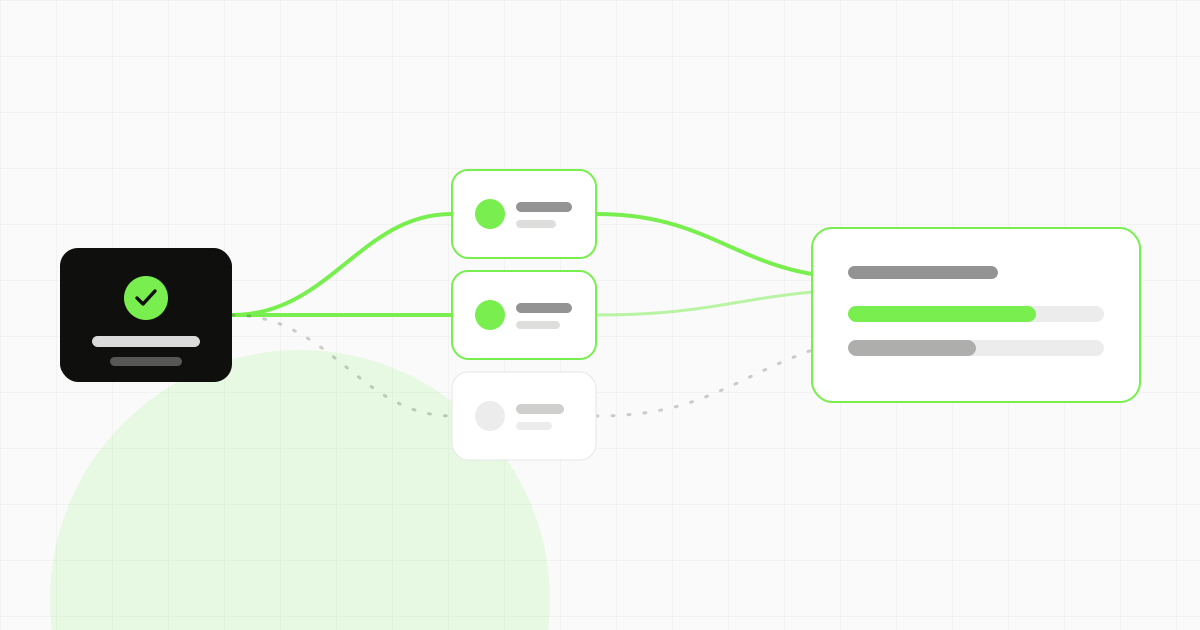
That sounds contradictory and is not. DA is an estimate of how Google probably treats a domain. It is a thermometer that reports the temperature without changing it.
How it is calculated
Moz uses a machine learning model evaluating mostly backlink data, a neural network since version 2.0. The training target is predicting Google rankings. Inputs include the number of referring root domains and their quality, in Moz's words dozens of factors in total. Values refresh daily. (Source: Moz, 2025)
Two things about that matter in practice.
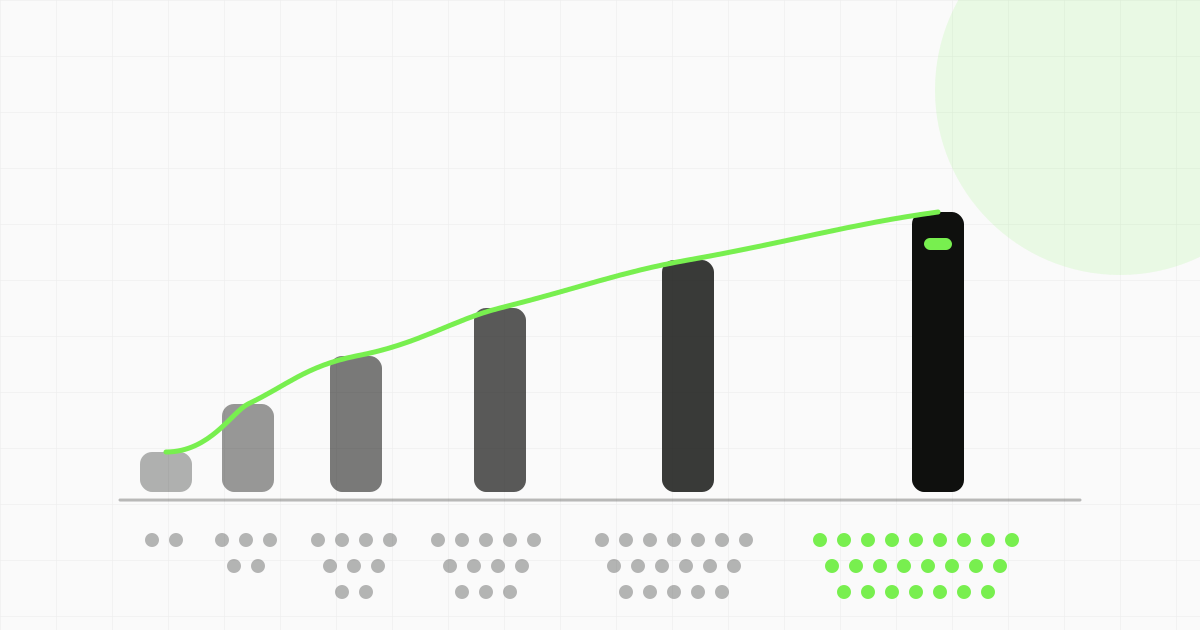
The scale is logarithmic. Moz puts it this way, a DA of 40 is not twice as good as a DA of 20. (Source: Moz, 2019) Climbing from 20 to 30 takes manageable effort, going from 70 to 80 is a different order of magnitude. Anyone setting goals in DA points should know this.
The model has not changed since 2019. Domain Authority 2.0 launched on 5 March 2019, and in 2025 Moz still names that rollout as the most recent model change. The number therefore judges with a model trained before search changed fundamentally.
What Moz published about its own accuracy is telling too. Across 16,000 US keywords studied, the correlation between DA and actual placement came to roughly 0.12. The engineer responsible called the lead over competing metrics underwhelming at the time.
What Google says
Precision pays off here, because the question gets answered wrongly on a regular basis.
Google has repeatedly denied keeping a domain-wide authority score. John Mueller said in 2016 there was nothing like a website authority score, and repeated in 2019 that Google does not evaluate a site's authority and assigns no score for it. Gary Illyes put it just as bluntly in 2016.
In its official documentation Google describes site-wide signals that feed into its understanding of individual pages, but no authority score as such.
What about siteAuthority from the leak?
In May 2024 internal Google documentation became public by accident. It contains a field named siteAuthority, described as converted from another internal signal. Google confirmed the documents were genuine while warning against drawing conclusions from incomplete information taken out of context.
Cleanly separated that means:
Established: a field by that name exists in the documentation and carries that description.
Not established: whether it affects rankings, how it is calculated, how heavily it is weighted, or whether it was ever in use at all.
Concluding from this that Google uses Domain Authority after all confuses two things. Even if Google did run a domain-wide signal internally, it would be an unknown quantity with a similar name. It would never be the Moz number.
The other authority metrics
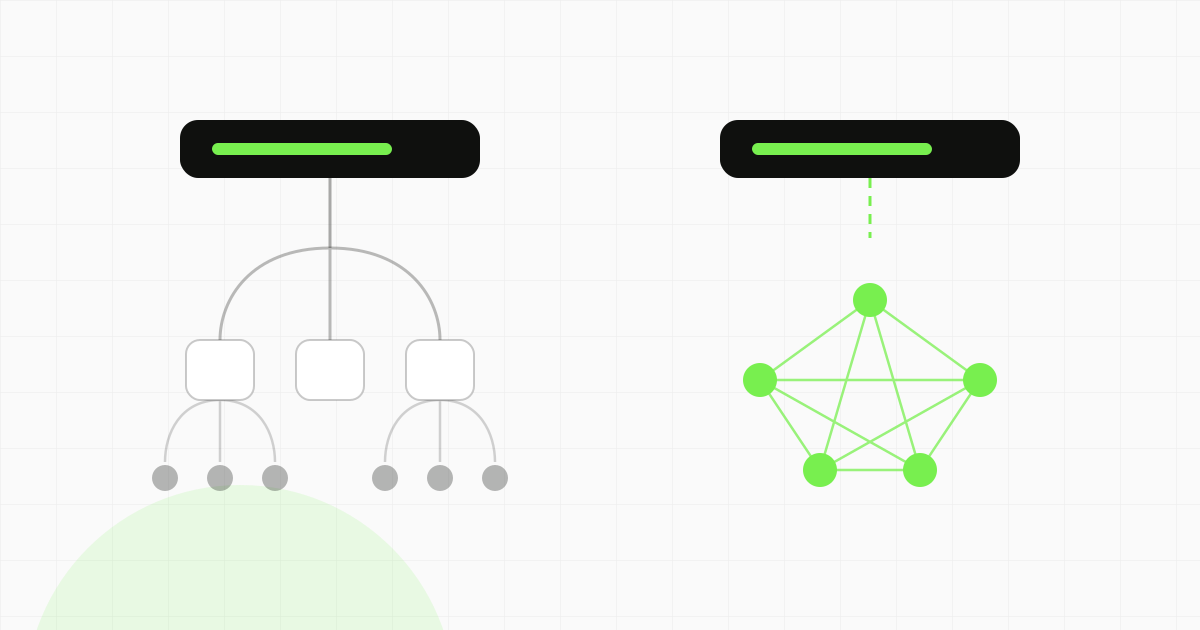
Every provider has its own number, and they do not convert into one another.
Metric
Provider
Scale
What it measures at heart
Domain Authority
Moz
1 to 100
learning model trained to predict rankings
Domain Rating
Ahrefs
0 to 100
strength of the link profile, computed from the link graph
Authority Score
Semrush
1 to 100
link strength, organic traffic and six spam indicators
Trust Flow
Majestic
0 to 100
trust passed down from a vetted seed set
Citation Flow
Majestic
0 to 100
link volume alone, with no quality assessment
How Ahrefs calculates its Domain Rating, and why the number says nothing about traffic, is covered in a piece of its own.
The difference is not cosmetic. Domain Authority is the only one of these explicitly trained to predict Google rankings. The others are computations over each provider's own link index. How Trust Flow and Citation Flow work in detail, and why the ratio between them says more than either value alone, is covered in our piece on Trust Flow.
Visibility in the search result is another matter again. Authority metrics assess the link profile, the visibility index assesses presence in search results. Two different questions.
Why the number can be manipulated
This is the part that counts when buying placements. And the evidence comes from the providers themselves.
Moz described openly in 2019 that Domain Authority had been deliberately attacked with spam to lift the score and sell domains at a higher price. The techniques used barely worked on Google, but they sufficed for the metric. (Source: Moz, 2019)
When switching to the new model, Moz measured how far values fell per group. The difference shows how much had been artificial:
Group
Drop in DA value
Random domains as a baseline
6.1 percent
Link buyers
15.9 percent
Comment spammers
34 percent
Link sellers
56 percent
Domainer networks
97 percent
Low-value auction domains
98 percent
The baseline is 6.1 percent, which is what ordinary domains lost from the model change alone. Everything above that is the share manipulation accounted for. For domains from auctions and networks the value was essentially constructed from scratch.
Ahrefs is equally direct about its own Domain Rating. Large amounts of low-quality backlinks may actually increase DR rather than lower it, because the metric does not account for spam. The provider concedes that practitioners exploited this gap to make money. (Source: Ahrefs, 2022)
On top of that sits a mechanism Ahrefs documents itself. A linking domain splits its rating equally across all domains it links to. Build a domain that links out to almost nothing, then point it at selected targets, and it passes on maximum value. Private link networks are built on exactly that.
The practical consequence. A high authority number on its own says nothing about whether a placement works. It says the domain's link profile looks good by that metric's rules. How to judge a link profile properly is covered in our piece on how to analyse your link profile.
How to use the number when buying placements
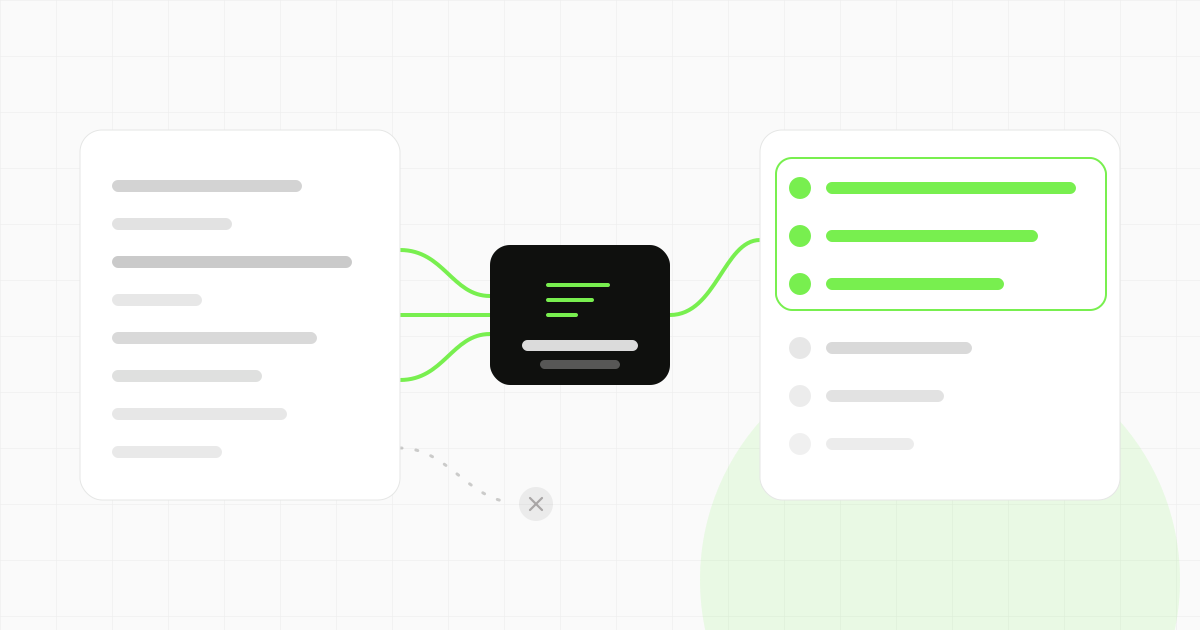
Domain Authority works as a first filter and fails as a basis for decisions. In practice that means:
Use it to rule out, not to choose. A domain at DA 3 you can skip. A domain at DA 60 you have not yet checked.
Look at organic traffic. A domain with a high authority score and no visitors is a warning sign. That mismatch is the signature of built-up domains.
Check topical proximity. A reference from your own field weighs more than one from a strong but unrelated domain.
See what else the domain links to. A site selling in every direction passes on less and carries more risk.
Compare two metrics rather than one. When Domain Authority and Trust Flow diverge sharply, a closer look pays off.
On the GetMentioned placement marketplace these figures sit side by side, so the choice does not hang on a single number.
A number you can buy is no criterion for buying. Domain Authority belongs in the shortlist and never in the decision.
David Hahn, Managing Director at GetMentioned
How to read the number from now on
Three things. Domain Authority is a third party's estimate of how Google probably treats a domain, and explicitly not a Google value. It is logarithmic, so high scores are disproportionately hard. And it can be manipulated, which both major providers openly concede.
Frequently asked questions
What is Domain Authority?
A metric from the provider Moz on a scale from 1 to 100. It predicts how likely a domain is to rank in search results compared with competitors.
Is Domain Authority a Google ranking factor?
No. Moz states plainly that the metric is not a Google ranking factor and has no effect on search results. Google has repeatedly denied using any domain-wide authority score.
What counts as a good Domain Authority score?
There is no universal target. Only the comparison with direct competitors in the same field carries meaning. Because the scale is logarithmic, high values are disproportionately hard to reach.
How do I improve my Domain Authority?
Through the same things that count with Google, namely references from topically relevant, genuine websites. Chasing the metric rather than the substance builds a result that can vanish with the provider's next model change.
What is the difference between Domain Authority and Domain Rating?
Domain Authority comes from Moz and is a learning model meant to predict rankings. Domain Rating comes from Ahrefs and computes the strength of the link profile. The values do not convert into one another.
Can Domain Authority be bought or manipulated?
The metric can be inflated artificially, and both major providers have acknowledged it. Moz measured in 2019 that values for link sellers and domainer networks fell by 56 to 97 percent once the model was hardened against manipulation.
Should I pick placements by Domain Authority?
As a filter yes, as the sole criterion no. What works is combining the authority score with organic traffic, topical proximity and a look at how the domain links out.
David has been building link acquisition and digital PR processes since 2016, first as an agency under SEO Galaxy, today as a platform with GetMentioned. He has scaled his own projects from zero to seven-figure monthly traffic and delivered thousands of campaigns for clients. Here he writes about what works in practice, and about what only costs budget.
Your next link does not have to be a blind buy
Compare publishers, SEO data and prices in one place and book the placements that fit.
Domain Rating measures the strength of a backlink profile, calculated from dofollow links. It says nothing about traffic, topic or how Google treats the domain. Why the scale is logarithmic, and which of six common claims hold up.
Trust Flow looks like a decision number, and that is exactly the problem. How the Majestic metric is built, what counts as a good value, and which decisions you can actually take from it.
How to evaluate a link profile: which data you need, which metrics say something, how the competitor comparison works and what comes out as a work list.