Referring domains: what the number measures and what it means when buying
Referring domains count websites, backlinks count individual references. Confusing the two costs money at the point of purchase. Why the widely quoted figure of 200 has no source, what the most recent open study shows instead, and how to read the metric before booking.
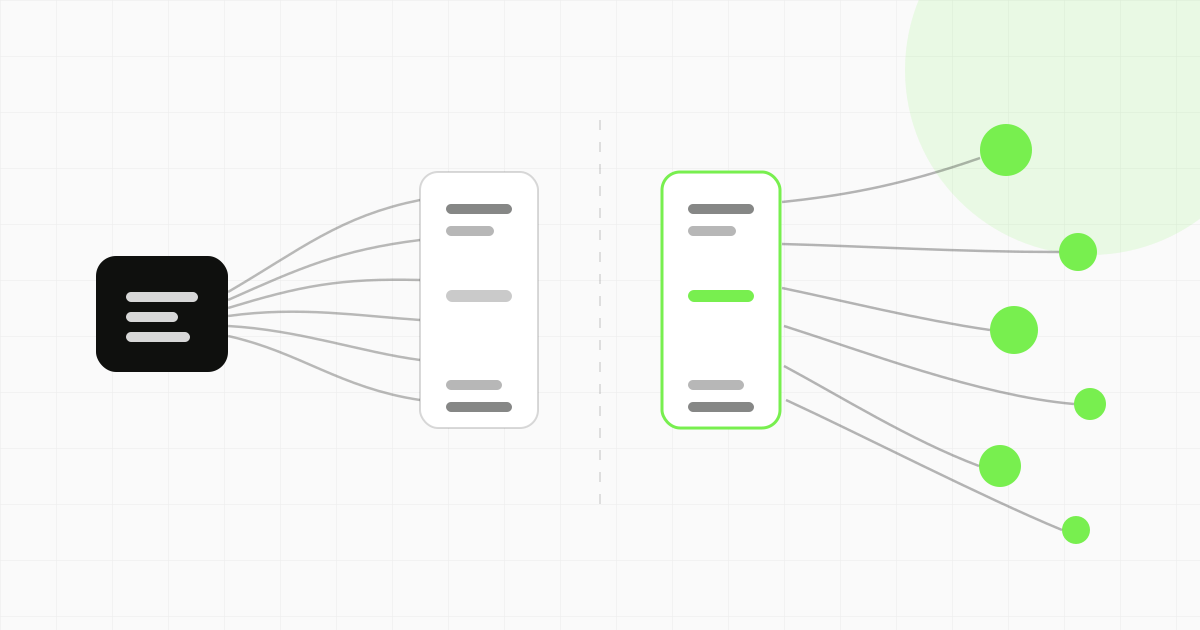
Referring domains are the websites that hold at least one backlink pointing at a target. Tools also label them unique referring domains or linking domains.
Ahrefs runs a help article titled "What's the difference between referring domains and backlinks". It reads: "Backlinks are hyperlinks that point from one website to another. You can have multiple backlinks from a website or web page." Referring domains, by contrast, are "domains from which the target website or web page has one or more backlinks". (Source: Ahrefs, updated 31 October 2025)
Ahrefs gives an example. If the New York Times and Forbes both link to a page, that is two referring domains. If the New York Times links twice, it stays one.
The arithmetic rule follows. The number of referring domains is always equal to or smaller than the number of backlinks.
A second article on the same website changes nothing. That holds even in a different subfolder.
The difference from backlinks in four lines
Feature
Referring domains
Backlinks
What gets counted
the linking website
the single reference
Second link, same website
not counted
counted
What the number says
how many sources point at you
how often they point
Upper limit
the websites in the index
none
Both values give you a ratio, backlinks divided by referring domains. It shows how often one source links on average.
A high value usually has one of two causes. Either the link sits in a footer and appears on every subpage. Or a website has written several articles over the years pointing at the same URL.
In the backlink count both cases look identical. In the referring domain count you see the difference.
The path a single reference takes before it moves a ranking is in our piece on how backlinks work.
Where to read the number
Ahrefs shows both values side by side in Site Explorer under backlink metrics. The referring domains report lists the linking websites, the "Links to target" column the number of references per row.
A dofollow filter narrows the list to domains that pass value. That view yields insights a plain backlink count cannot.
Semrush carries the metric in Backlink Analytics, Moz in Link Explorer. Google Search Console lists the referring web pages Google itself knows under "Links".
Two tools rarely report the same value for the same site. Every provider runs its own bots and counts subdomains by its own rules.
So the absolute value carries little and the comparison a lot. How a full audit runs is in backlink analysis.
What the number says about a link profile
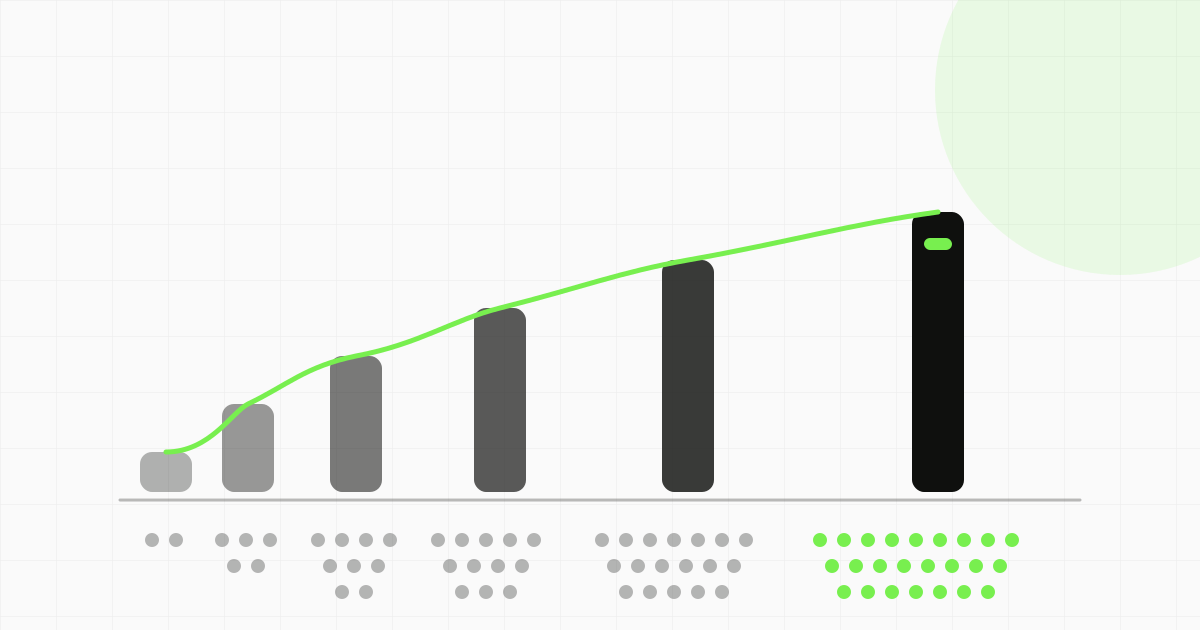
Ahrefs adds an observation from its own index in the same article. There is "a positive correlation between the number of unique referring domains and organic search traffic". That is a relationship and not a cause.
For judging a link profile the spread matters. A profile of 180 referring domains reads differently from one of twelve, even when both carry 200 backlinks.
The metric also sits inside other metrics. Ahrefs computes Domain Rating from referring domains rather than from references. Repeat links from the same website do not lift the score.
Moz runs Page Authority for the single page, Semrush an Authority Score for the domain. What sits behind the Moz number is covered in our piece on Domain Authority.
Five common claims, fact checked
Claims circulate about this metric that can be held against the primary documentation. We checked five.
Claim
Finding
Pages ranking #1 in Google have over 200 referring domains on average
fails. No openly readable study supports the number
A balanced ratio of backlinks to referring domains protects you from manipulation claims
fails. Google names no ratio
Referring domains show Google that your site is trustworthy
fails. The term is absent from Google's documentation
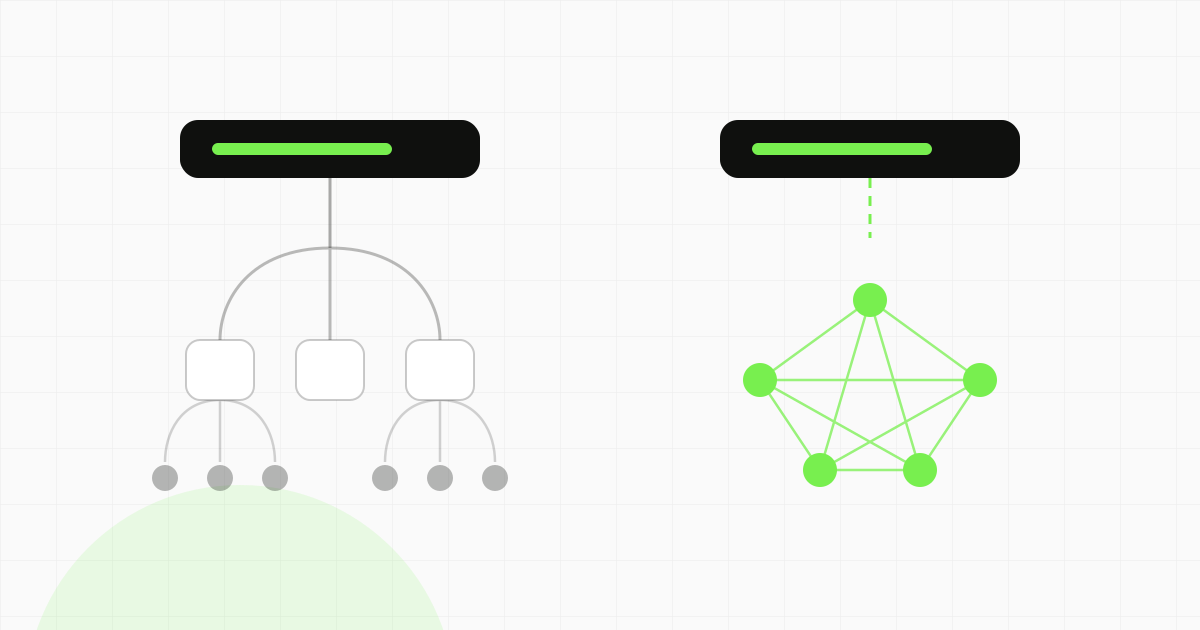
The diversity of referring domains outweighs the number of backlinks
holds. It follows from the counting rule
Business directory listings deliver valuable backlinks
partly holds. Google lists "Low-quality directory or bookmark site links" as link spam
For the claim about 200 referring domains no openly readable study exists. The figure given is an average. With link counts the average and the median sit far apart, because a few domains have built enormous profiles.
The most recent open measurement comes from WebFX, collected in March 2026. It covers 1,462 domains ranking on page one for 150 commercial queries across 15 industries. The median sits at 907 referring domains, from 76 in apparel to 3,027 in finance and insurance. (Source: WebFX, 8 April 2026)
Three limits belong with that. It measures page one and not position one. It measures per domain and not per URL. And the queries were pre-sorted by competition.
Two things still stand. No universal target value exists. Between the weakest and the strongest industry sits a factor of 40.
For the second claim there is no Google source at all. The spam policies define link spam as "the practice of creating links to or from a site primarily for the purpose of manipulating search rankings". A ratio of backlinks to referring domains appears nowhere in them. (Source: Google Search Central, updated 15 May 2026)
Google's document on helpful content leaves out references from other websites entirely. (Source: Google Search Central, updated 10 December 2025) Nothing at the search engine supports the role of this metric as a ranking factor. It comes from the tool providers and describes their index.
Five common claims and what survives of them. Checked against the Ahrefs documentation and Google Search Central.
Why ten fitting domains beat a hundred random ones
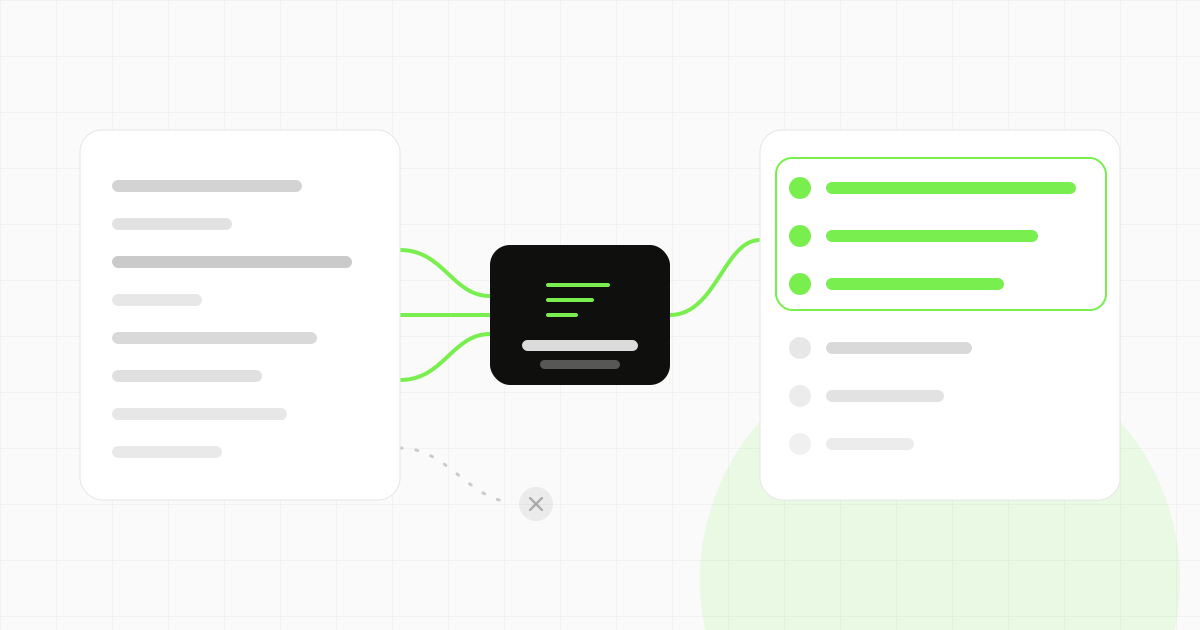
Quality beats volume. Every row in the report counts the same, and the effect does not.
A referring domain from your own field sits inside an article your buyers read. One from a directory sits in a list with no audience.
Four features separate the two cases:
the relevance of the topic to your own landing page
the organic traffic of the linking website
a real editorial desk instead of auto generated pages
few outbound references instead of links in every direction
Not every page needs backlinks. Pages with commercial value and competitors need the right sources.
In our experience topical fit decides more than the figure in the report. A small trade title from your own field carries further than a large domain from someone else's.
How to read the number when buying a placement
Buying flips the arithmetic. A booked placement adds at most one new referring domain.
If the publisher already sits in your link profile, no new source appears. That second placement can still make sense, for another target page.
Five checks before you book:
Does the domain link to you already? Then it is not a new source.
How many domains does it link to otherwise? The influence per target drops with every further one.
Does the topic fit your target page?
Does the website draw organic traffic from search engines?
Does the price performance match the likely impact?
The GetMentioned Score brings price, SEO data, authority and likely impact together, rather than judging publishers on a single number. MentionIQ adds which domains link to your competitors in the SERPs and not to you.
An offer of fifty backlinks sounds bigger than five placements. It is often the same thing, told at a higher price. With every offer I check first how many new sources come out at the end.
David Hahn, Managing Director, GetMentioned
How the number of referring domains grows
The number grows when a website links that has not linked before. Three ways lead there:
content that gives a reason to link, such as original data or a calculator
digital PR and brand mentions in trade media that cover your topic
booked placements with publishers who are not yet in your link profile
Content marketing works slowly and broadly, booked placements fast and narrowly. Both belong in an SEO strategy aimed at visibility in search results.
The expensive part is researching suitable publishers. In the GetMentioned marketplace, Domain Rating, traffic, topic and price sit side by side per publisher, plus whether the domain already links to you.
If you would rather hand the work over, we take it on in our managed service. We deliver full service in link building and no full service SEO.
What referring domains tell you
Three sentences remain. Referring domains count sources, backlinks count references. The number cannot be lifted by more links from the same place. And no universal target value exists.
For buying, one question follows. How many new sources does this booking produce?
Frequently asked questions
What are referring domains?
The websites that hold at least one backlink pointing at a target. Each one counts once, whatever the number of links it sets.
What is the difference between referring domains and backlinks?
Backlinks are the individual references, referring domains the websites behind them. Two links from the same website give you two backlinks and one referring domain.
How many referring domains does a page need?
There is no universal figure. In the WebFX measurement from March 2026 the median for page one was 907, the industry range 76 to 3,027.
Do more referring domains improve your search engine ranking?
Ahrefs reports a positive correlation between the number of referring domains and organic traffic. A correlation is not a cause, and Google names the metric as a ranking factor nowhere.
Does a subdomain count as its own referring domain?
The provider decides. Ahrefs usually folds subdomains into the root domain and makes an exception for platforms with separate user areas.
Why do two tools show different numbers?
Because every provider runs its own bots and crawls a different share of the web. Ratios and comparisons are more reliable than absolute values.
How do I check a competitor's referring domains?
Through the referring domains report of a backlink tool. The interesting part is the overlap, the domains linking to several comparison pages and not to you.
David has been building link acquisition and digital PR processes since 2016, first as an agency under SEO Galaxy, today as a platform with GetMentioned. He has scaled his own projects from zero to seven-figure monthly traffic and delivered thousands of campaigns for clients. Here he writes about what works in practice, and about what only costs budget.
Your next link does not have to be a blind buy
Compare publishers, SEO data and prices in one place and book the placements that fit.
Domain Rating measures the strength of a backlink profile, calculated from dofollow links. It says nothing about traffic, topic or how Google treats the domain. Why the scale is logarithmic, and which of six common claims hold up.
How to evaluate a link profile: which data you need, which metrics say something, how the competitor comparison works and what comes out as a work list.
The visibility index sums up a domain's Google rankings, weighted by search volume and click probability. What the number says, why it is a zero-sum game and what it stopped showing once AI Overviews arrived.